So who needs an MFA anyway?

What is an MFA?

It’s a Master of Fine Arts, so a form of post-graduate degree. The one that I studied was in creative writing, something which over recent years has become a favoured form of post-grad qualification if you’re in the business of writing.

If I’m a writer then, do I need one of these?

No, you really don’t need one.

So why did you want one?

My work was feeling a bit stagnant. Plus, I had a novel on submission to agents and no-one was calling back, so I needed the proverbial kick up the backside to start my next project. Oh and there was a pandemic on, did I mention that?

No, but I’ve spent the intervening time rocking back and forth in a foetal position pretending it never happened. So, how does this MFA thing work?

Depends on whether you’re enrolling full time or a part time. As a part time student, my course was two years long. The first year was focused on weekly lectures, reading, essays and craft. The second was a 40,000 word dissertation which is effectively a novel excerpt.

What are other common reasons for studying one?

There’s an assumption, I think, that you might need one if you ever wanted to teach creative writing (untrue). Secondly, there’s the hope (often sub-textually hinted at in the glossy brochures) that enrolling on one of these courses might help your career, either by aiding you in snagging an agent or a book deal. (This too, is pretty much a load of old cobblers).

Finally and most importantly perhaps, there’s writerly validation. If you’re putting your stuff out there on an even semi-regular basis, it’s easy to become prey to the creeping suspicion that you might not be any good. Being around a group of generous well-read writer types can really help you feel like a proper writer.

Are you a proper writer?

Why’d you have to go and ask that?

Okay, so what were the good things about the MFA?

One of the most useful things was the encouragement to take my work seriously. By this, I don’t mean shaking my fist at a world that refuses to understand my genius. Rather, I mean understanding more about other writers and the contemporary ‘context’ and seeing how you fit into it (or not).

Doing this sometimes meant writing essays about your own unfinished work, which is totally odd and arguably self-indulgent as a practice but, which was weirdly useful. It gives you context, distance and the ability to assess your work as a piece of ‘literature’. (I know, right?)

Secondly, there was the amount of required reading. Having an excuse to sit around and read was a real luxury, not to mention being liberated from the torment of choosing what to read next.

Anything else?

The best thing was probably the the aspect of the course that the faculty had the least control over, that is: the other people on it. Mixing writers together often has unpredictable results. At one end of the spectrum are the groups presided over by bores who wang on endlessly about manuscript format and at the other are the Milfords I’ve attended where most attendees are generous with their thoughts and feedback.

Thankfully, our MFA squad was totally the latter rather than the former, to the extent that even after a couple of years of post-graduation we’re in still in contact and reading each other’s work.

Ok, enough with this rosy glow BS , how did it suck?

Well, the obvious thing was how expensive it was. And it was hard to shake the feeling that once you’d ponied up your fees the university weren’t that bothered about much else.

The second year was a bit disappointing too. While the first focused on some great lectures, craft and reading, the following one was a much more isolated affair, with each of us toiling away on our dissertations/manuscripts with our respective supervisors.

The only break from this was a ‘summer term’ which consisted, for the most part, of an academic circle jerk wherein members of the faculty interviewed each other about their upcoming books.

So was it worth it?

I suppose if I consider this in purely concrete terms it was a failure. Did it help me land and agent? No. Did it help me get a book deal? Nuh-uh.

This is going to be one of those, “it’s about the journey,” things isn’t it?

But it is is an about the journey thing, my dude. I’m pretty certain I’m a better writer because of the books that I read (even the ones I disliked) and the essays I wrote. Most importantly, I’m probably a better writer because of the feedback I gave and received from my fellow students. Looking back, that’s ultimately what made it worth the time and money.

Fair enough. Are you a proper writer now then?

FFS.

new story at egg+frog

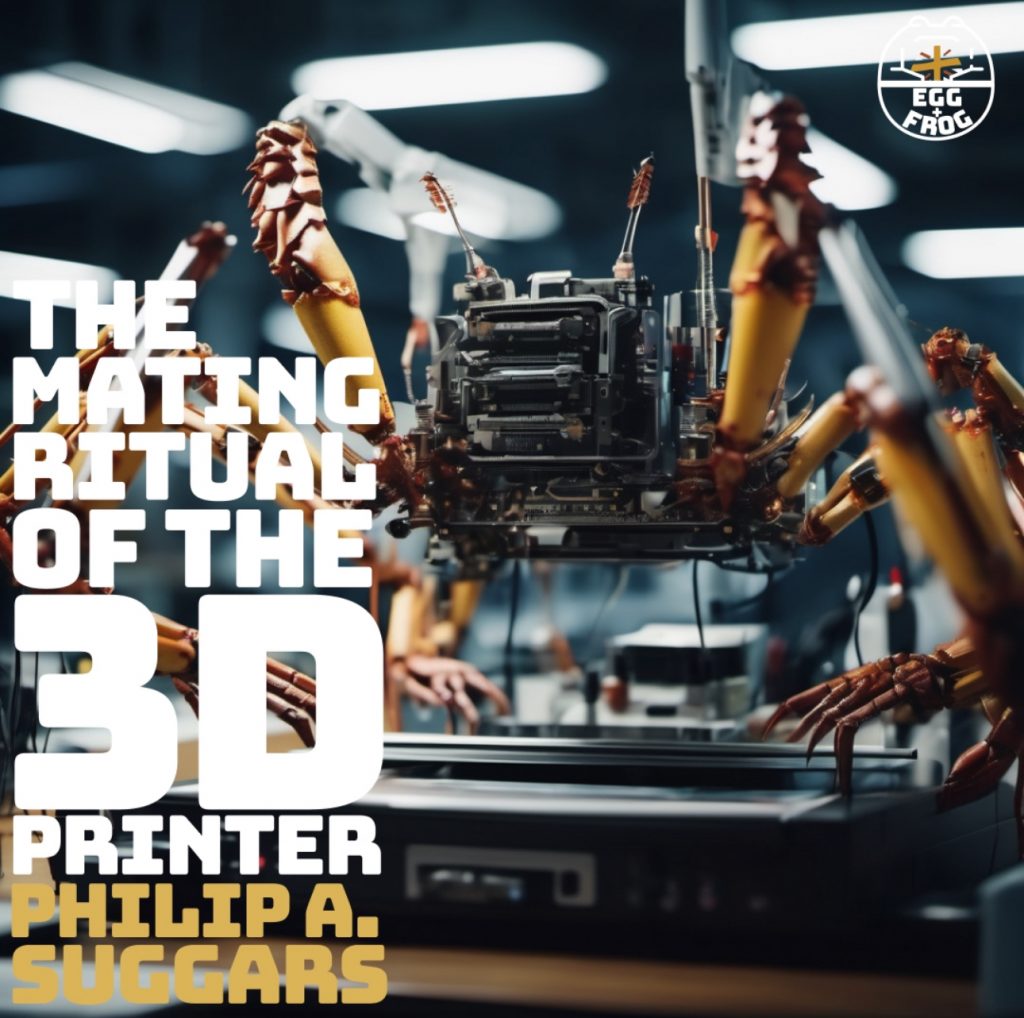
my short story The Mating Ritual of the 3D Printer is now up at the excellent egg+frog a new journal of British writing. Read it here:

bsfa best fiction long-list: good vibrations

I’m delighted to announce that my story good vibrations, published by the mechanics institute review last year has been long-listed for the bsfa best short fiction award.

bsfa logo

You can read the story here and see the full longlist here.

hulk is tired

I’m not exactly sure when it happened, but I think I might be a bit bored with speculative fiction. Or perhaps, speculative fiction is a bit bored with me.

Could it be that we’ve just been seeing too much of each other during lockdowns one through three?

“It’s not you, it’s me,” spec-fic might say on our regular date night held in the corner of a friendly tavern (built beneath the shadow of towering rocket-ship).

Certainly, I seem to have read a lot of speculative fiction lately that simply moves the genre furniture around the house rather than adding a new wing (or preferably) trap-door to it.

It’s a thought that reminds me a little of what Robert Eaglestone thinks is genre’s birth defect. For him, literary fiction is really where it’s at.

“It says everything,” he says. (Which is the whole point apparently.)

From his perspective, genre fiction, too-often, is only ever talking to and about itself.

And while I think this observation does articulate some of my own weariness, how to square this with his rather contradictory special pleading for lit-fic itself, which he regards as a non-generic type of writing whose tendency to be in conversation with its own history is validation of its uniqueness rather than a flaw.

As an aside, I wonder if beneath some of the slightly sniffy attitudes expressed towards spec-fic in literary circles lies the fact that it often sells a lot better than literary fiction.

Having all that filthy lucre smeared over your tentacles means that genre
cannot be art at all, rather it is something commercial, hybridised and
degraded. That said, Dickens and Cervantes both turned out contemporary
best-sellers and you can’t get much more canon than little Davy Copperfield or the Madman of La Mancha. (It’s possible then, that perhaps critics will even regard Stephen King a little more kindly in a hundred year’s time.)

So, I’m not entirely sure where this slightly circular and self-indulgent post has got me.

Perhaps, I should start seeing other genres?

I’ll be honest about it with speculative fiction. We’ll go to the usual place on date night, drink half a bottle of chianti and work out some ground rules. Without them, in this sort of situation, someone will always get hurt. (Most probably be me.)

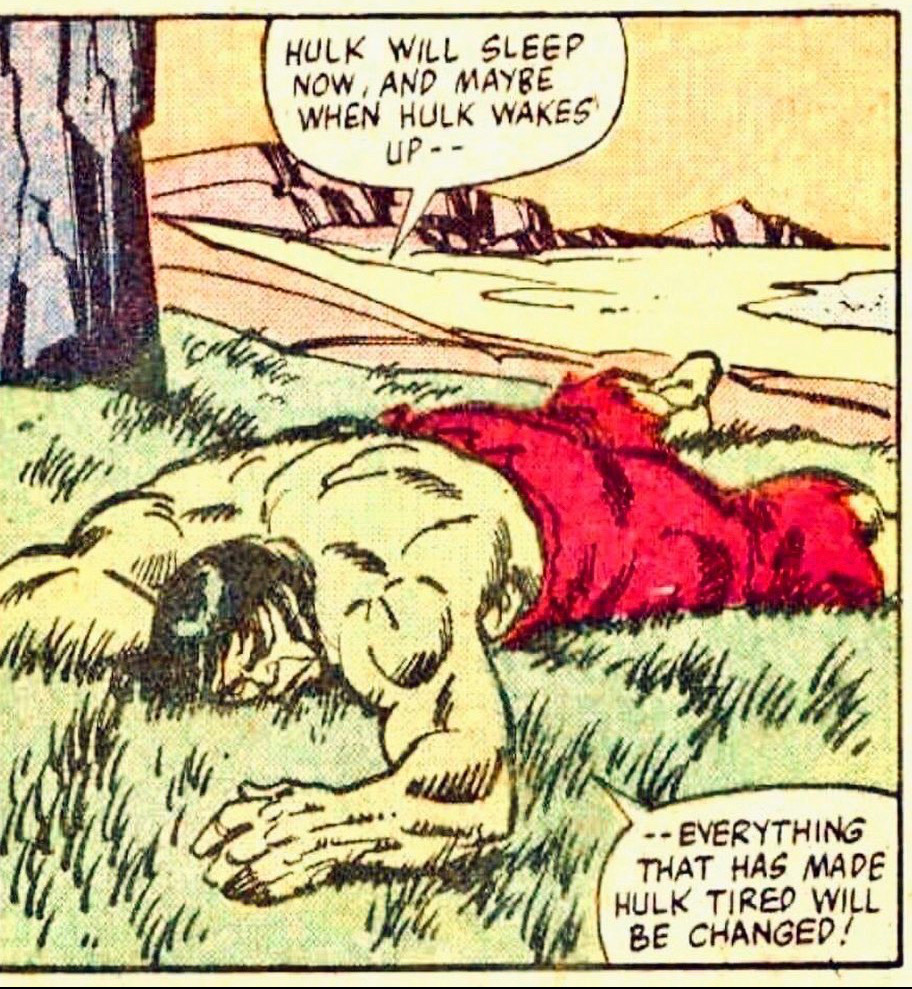
Or perhaps, after all, it really is just as the picture below says: Hulk is tired and Hulk should have a nap.

Image of the hulk sleeping. “Hulk is tired.” He says, “Hulk will sleep and everything that has made Hulk tired will change”
Hulk is really tired.

autonomicon

autonomicon is a simple bot inspired by Alan Trotter and Allison Parrish’s work that generates Lovecraftian automatic writing by pulling random snippets from an online resource storing Lovecraft’s corpus and splicing it together with words suggested by a simple statistical API.

To use just click the ’Summon’, button to get the next word from the bot or select one of the word tiles to add your own choices into the mix. The algorithm determines which words are the most likely to follow the last word displayed (the numbers beneath them are a measure of probable occurrence).