Alien³: of bald caps and bad dreams

[Warning: contains a brief mention of sexual violence and major spoilers for Alien³ ]

Welcome to an occasional series of posts where I kick around sequels that are widely derided and make a case for their re-evaluation.

– Bangs gavel –

So, in the dock before us today we have: Alien³.

The case against the second sequel to Squidly Rott’s (sorry) haunted house in space film is pretty well documented, but let me summarise it here.

  1. In its first ten minutes, the movie does away with two of the emotional anchors of its immediate predecessor, Aliens, namely Newt and Hicks. Emotionally it’s all downhill from here.
  2. There are long stretches of the movie where there’s not much tension (and very little else).
  3. The quadrupedal alien, aka man’s worst friend/xeno-woof, is objectively goofy.
  4. The inhabitants of Fiorina 161 (Fury) present a cast of poorly developed characters, most of whom all blur into one dude with a skinhead and a Bible-itch.
  5. They kill Ripley
  6. THEY KILL RIPLEY
  7. I SAID THEY KILL RIPLEY!

Traditionally, the movie’s apologists have pointed to the chaos around the film’s production and it’s worth taking a moment to remember exactly how much of a definition of development hell this movie was.

So stay frosty, people, I’m going to do this as quickly as I can, (you can also just skip ahead. For those gentle readers with a yen for this sort of grimoire there’s an in-depth account here):

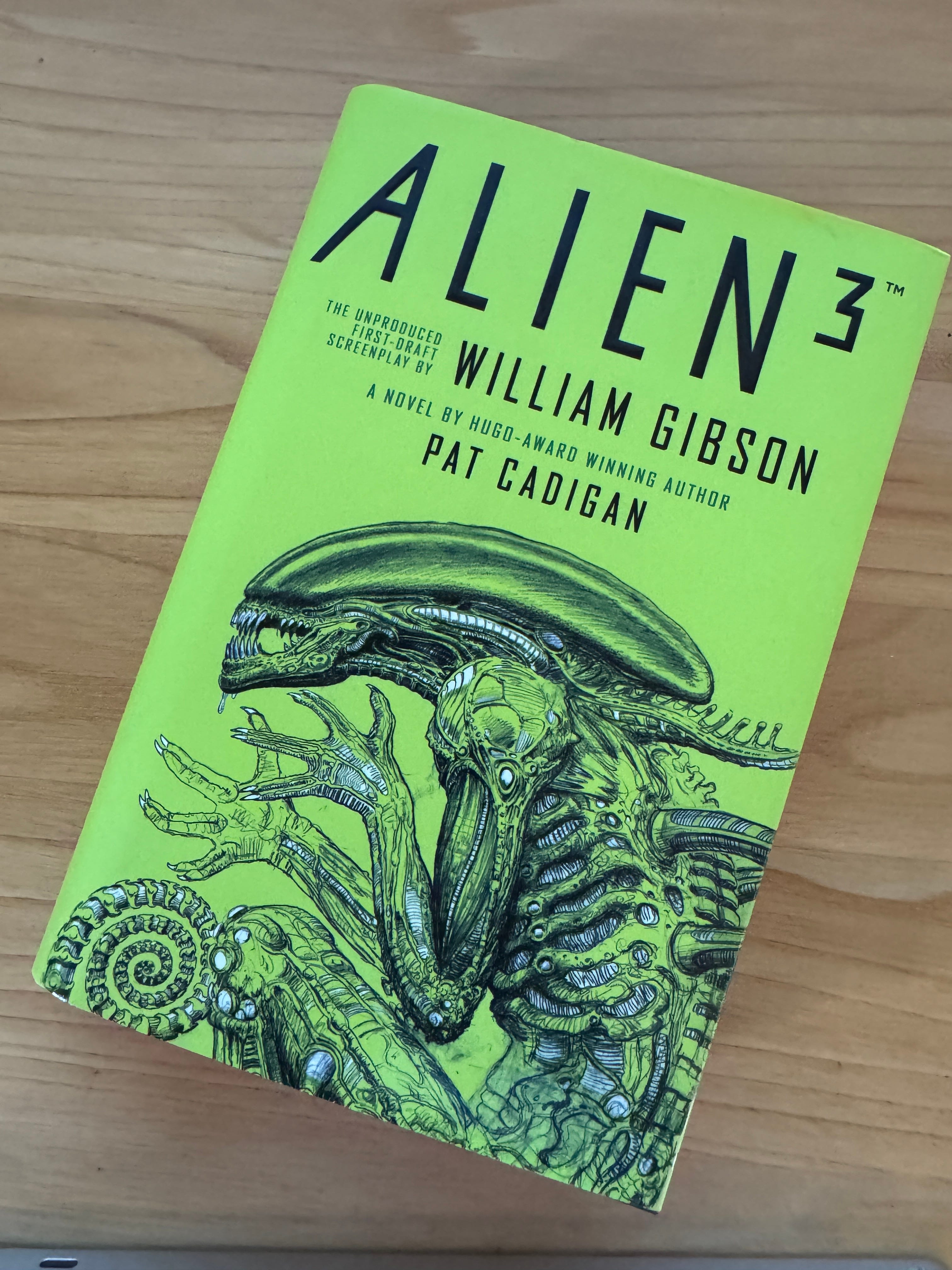
The mere existence of this book speaks volumes

Producers Walter Hill & David Giler hired William Gibson for a cyber-punk styled sequel that Fox airlocked, then Renny Harlin (Die Hard 2) came aboard with Eric Red (Near Dark) just as Sigourney Weaver became disillusioned on the series’ obsession with guns, so David Twohy (Critters 2) delivered a Cold War-in-space draft without Ripley until Fox demanded her reinstatement, after which Vincent Ward (The Navigator) pitched his space-monks on a five-mile wooden planet with writer John Fasano before being jettisoned because, well, actually insane, whereupon rookie David Fincher inherited the mess with Larry Ferguson (Highlander), whose portrayal of Ripley Sigourney Weaver rejected, which forced Hill & Giler back, only for them to be secretly rewritten by Rex Pickett when Fox hated their ending, in a move worthy of Weyland-Yutani itself. Giler then produced another nine(!) revisions of the movie, but by this point they were already building sets.

(Phew.)

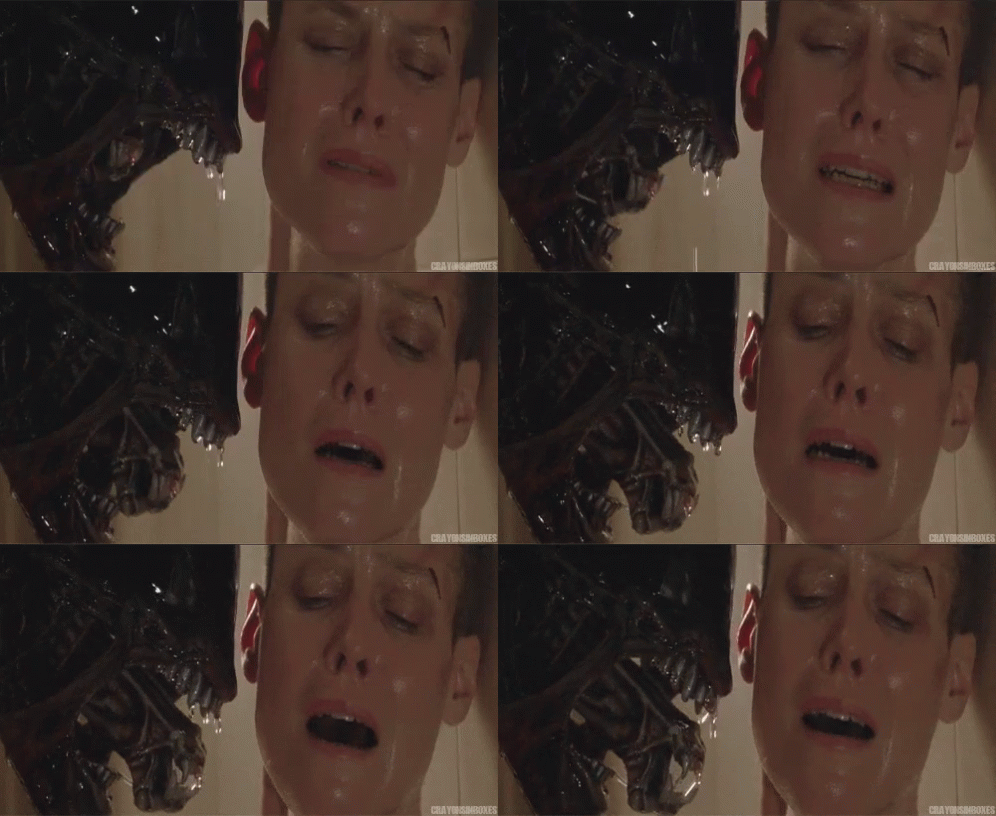
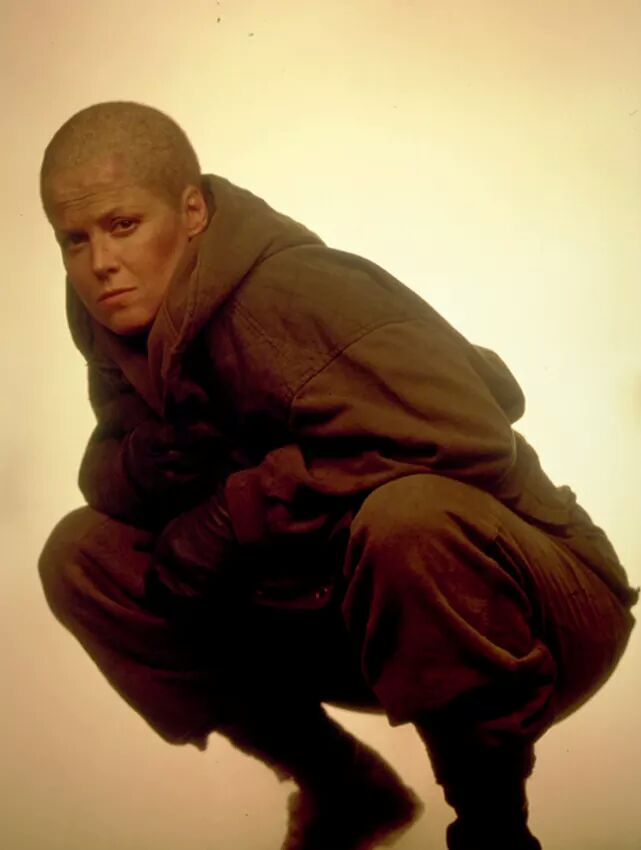
David Fincher has famously stated that working on Alien³ was the worst experience of his life due to Fox’s overbearing presence. After filming wrapped, there were extensive reshoots and extra sequences inserted into the film at the studio’s insistence prior to its release. (And let’s not even mention those dire publicity photos of poor old Sigourney in a bald cap).

Buy me a cup of tea?

Eventually, the movie was released in 1992 to very mixed reviews and domestic underperformance. Fincher himself (perhaps unsurprisingly) treats the film the way the rest of us treat the last two Indiana Jones sequels. I mean, there were only ever three Indy movies right?

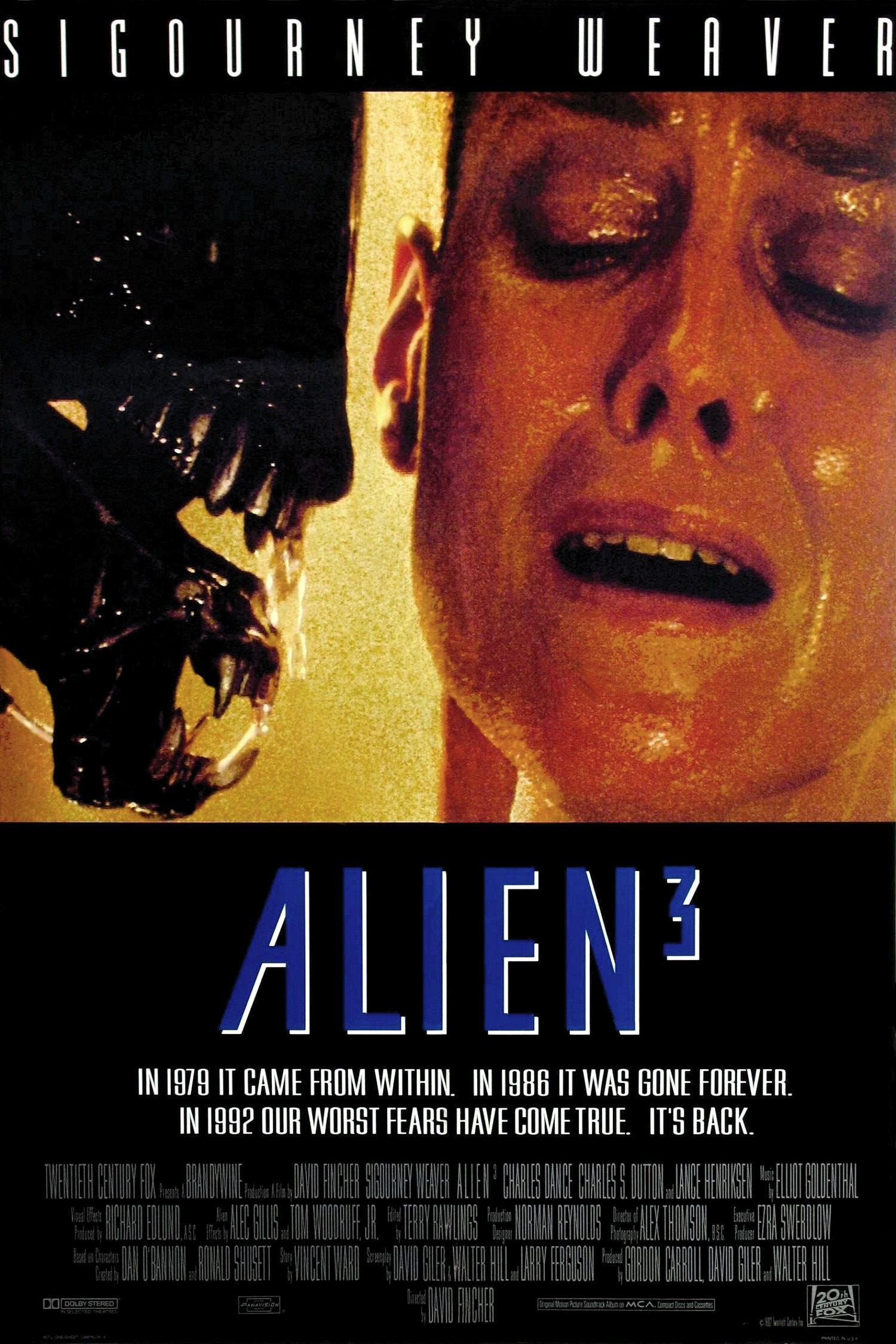
Alien 3 DC | Movies / Series | Filme aliens, Filmes classicos e ...
Whoever produced this poster’s strapline clearly had no sense of irony.

But, despite (and perhaps because) of this, Alien³ is deeply weird and eerie, certainly possessed of a more haunted and tragic atmosphere than any predecessor or sequel. Certainly, I can’t imagine any contemporary franchise instalment taking the risks this film does and one could make the case that the film’s balls-out nutso bravery flies in the face of the reheated duds that have come in its wake.

So, working through the common objections one by one:

Newt & Hicks, nixed.

Yeah, a difficult one, but I think Newt and Hicks not making it to Fury works pretty well as a statement of intent. This film is a departure from what has come before and it sets the tone unashamedly for what’s to come. This isn’t going to be a gung-ho film about space marines.

Newt and Hicks’ deaths also mean that Ripley is grieving throughout the narrative and Weaver’s performance is easily the best thing about the film. In fact, I’d argue that it’s her best work in the series. The loneliness, vulnerability and strength that she brings to the portrayal of grief here are visceral.

Nothing to see here, (prison) guvnor

Similarly, I’d argue that the long lingering shots of the corridors and ventilation shafts that comprise Fury’s prison facility are freighted with a deep sense of liminal horror. The opening scene, where the camera creeps through the crash debris of the EEV, its slow tracking through the tunnels and shafts of the lead-works combined with the surveillance footage of deserted corridors, crackling fluorescent lights and humming machinery are all reminiscent of Nikolaus Geyrhalter’s deep-time classic Homo Sapiens. These are all spaces that should be populated, but aren’t, possessed of a sense of dread, of something missing or withheld, charged with the same creepypasta unease as the Backrooms.

if you’re enjoying this, you could buy me a cup of tea

Depopulated, de-centred

Nowhere is this eerie payload more evident than in the emergence of the creature itself. This chest-bursting moment is at complete odds with the gross-out splatter-core of the original movie. In both the theatrical version and the assembly cut the alien’s birth is intercut with Hicks and Newt’s funeral, but in each version, the xeno-woof (theatrical)/oxo-morph (assembly cut) emerges from its animal host in an unpeopled space. In the assembly cut ,the birth is even followed by a long, lonely pull-out from Babe the ox showing the birth site surrounded by empty space.

Even with poor Spike the dog’s death throes in the theatrical cut, the birth scene has an odd, disassociated feel to it more than one of straightforward horror. Partly, I think, this is because at this point in the series chest-bursting had become an expected staple of the Alien movies, but also because, yet again, this pivotal scene is happening unbeknownst to Ripley and the prison population. The humans are de-centred in their own story.

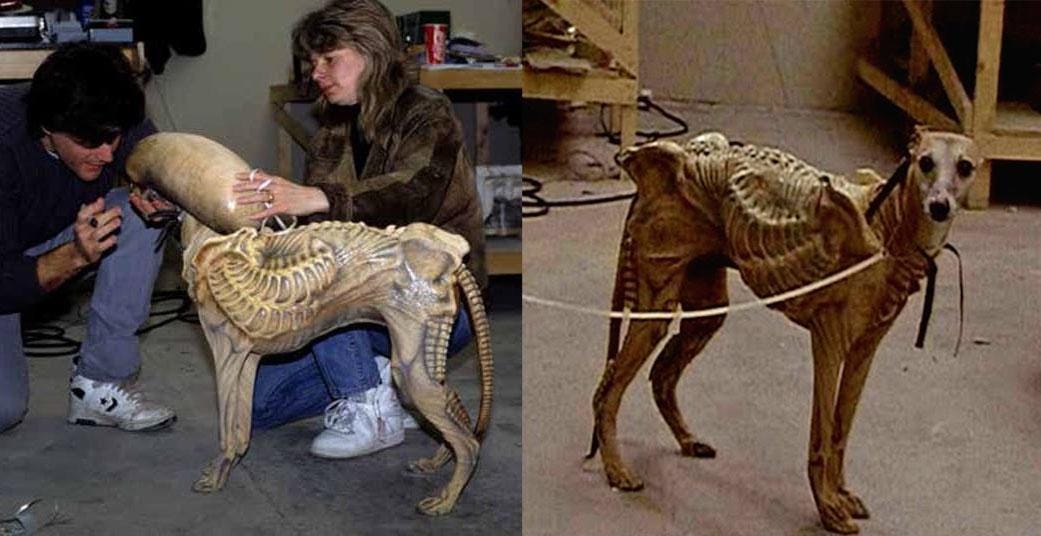
This Whippet was originally planned to star as the Xenomorph for a ...
Whippet … good? (with apologies to Devo)

Xeno-woof/Oxo-morph

Much has been made of Fincher’s dog-in-a-suit xeno-woof, but in the film’s defence the only dog shots are mercifully brief and, in the assembly cut, were cleaned up by the DVD restoration team with greatly improved compositing. For me, the creature works as a classic form of weird ontology that upsets categories, is it a dog/ox/alien? The cute post-birth puppetry of the bambi-burster only reinforces how disturbing the creature’s mutability is.

Look at me! I am soooo cute!

But also, I will eat your fucking face.

A seven foot walking cock with metal teeth

It’s no secret that H.R. Giger designed the xenomorph to be a seven-foot ambulatory cock with metal teeth, but Alien³ is the only movie in the series that draws an explicit parallel between the creature’s threat to bodily autonomy and sexual violence.

From this point of view, it’s possible to view the prisoners’ lack of individuality, specifically their shaved heads, uniforms and blurred identities as a way of collapsing them into a kind of faceless hostile masculinity.

Certainly, from her first entrance into the prison mess hall, Ripley is the focus of a predatory male gaze and her female identity is blamed explicitly by the prisoner’s leader, Dillon, for bringing “temptation” into their midst.

This ugly mood comes to a head most starkly when a group of prisoners attempt to sexually assault Ripley at the lead-works, but is also directly paralleled in the way in which the alien itself “leers” over her later when it traps her in the infirmary, its secondary jaw hovering with what seems to be sexual menace.

Both of these grim moments stage Ripley’s body as a site of threatened violation, reinforcing patriarchal stereotypes and drawing uncomfortable parallels between male and monstrous aggression.

Chip in, so I can buy a bald cap of my very own?

THEY KILL RIPLEY!

Yes, they do. But there’s a grace and beauty in her final sacrifice. It can be read as a final and definitive act of agency and autonomy. A noble fuck you to Bishop 2 and the Weyland-Yutani goons trying to exploit her and the alien embryo that she carries.

Again though, the film (at least in its theatrical version) delivers a strange and disturbing final image. In her last moments, as Ripley tumbles to her death, the alien bursts from her chest. She grabs it, holding it in an uncanny mirror of a mother-infant embrace, cradling it until they’re both swallowed by the molten metal below.

It’s a touching and deeply weird moment, which feels to me at least, like a fitting and dignified capstone to the trilogy.

In the end, Alien³ may be flawed, but I would say that its utter strangeness and sombre mood make it far more than a failure. Yes, it is bleak, but it’s also a very weird and eerily singular film with an emotional impact that, for me at least, lingers long after the credits have rolled.

But, more importantly, what do you think?

Playlist:


My debut fantasy novel, The Lighthouse at the End of the World is published on April 7th 2026 by Titan Books. Pre-order it here.

“It Follows” and the emotional register of late-stage Capitalism

I’ve read a lot of articles recently that chuck around the phrase, “the logic of late-stage capitalism” as a kind of rhetorical flourish. Hell, I’ve probably written a few myself, so I‘m not throwing any shade here. But it’s hard to read these words without thinking about the oft-quoted line (attributed to both Frederic Jameson and Slavoj Žižek) that, “it’s easier to imagine the end of the world than the end of capitalism.”

Saying we’re in “late-stage capitalism” though, kind of implies that we’ve moved through earlier stages and are now somewhere near a known ending. It has all the portentousness (and silliness) of a song by The Shamen. The logic at play here is more Captain Kirk than Mr Spock, enabling us to turn out despairing articles, give a Gallic shrug and then pop down to Waitrose for more hummus without troubling ourselves too much with what might actually come next.

From a historical perspective, this feeling is familiar. As far back as ancient Rome, figures like Cato and Cicero made their names partly by weighing in on the decline of civilisation. So believing the end is nigh seems to be a recurring cultural pattern. In my own lifetime alone we’ve had nuclear annihilation, Y2K and the War on Terror. None of these were trivial periods to live through, but we often seem to dramatise the present moment as a final gasp. Maybe, it helps to give the quotidian a glamorous touch of black lipstick. And maybe that’s part of the horror genre’s appeal (well, that and the lipstick).

“Metaphor for capitalism, innit” – Hobie tells it like it is.

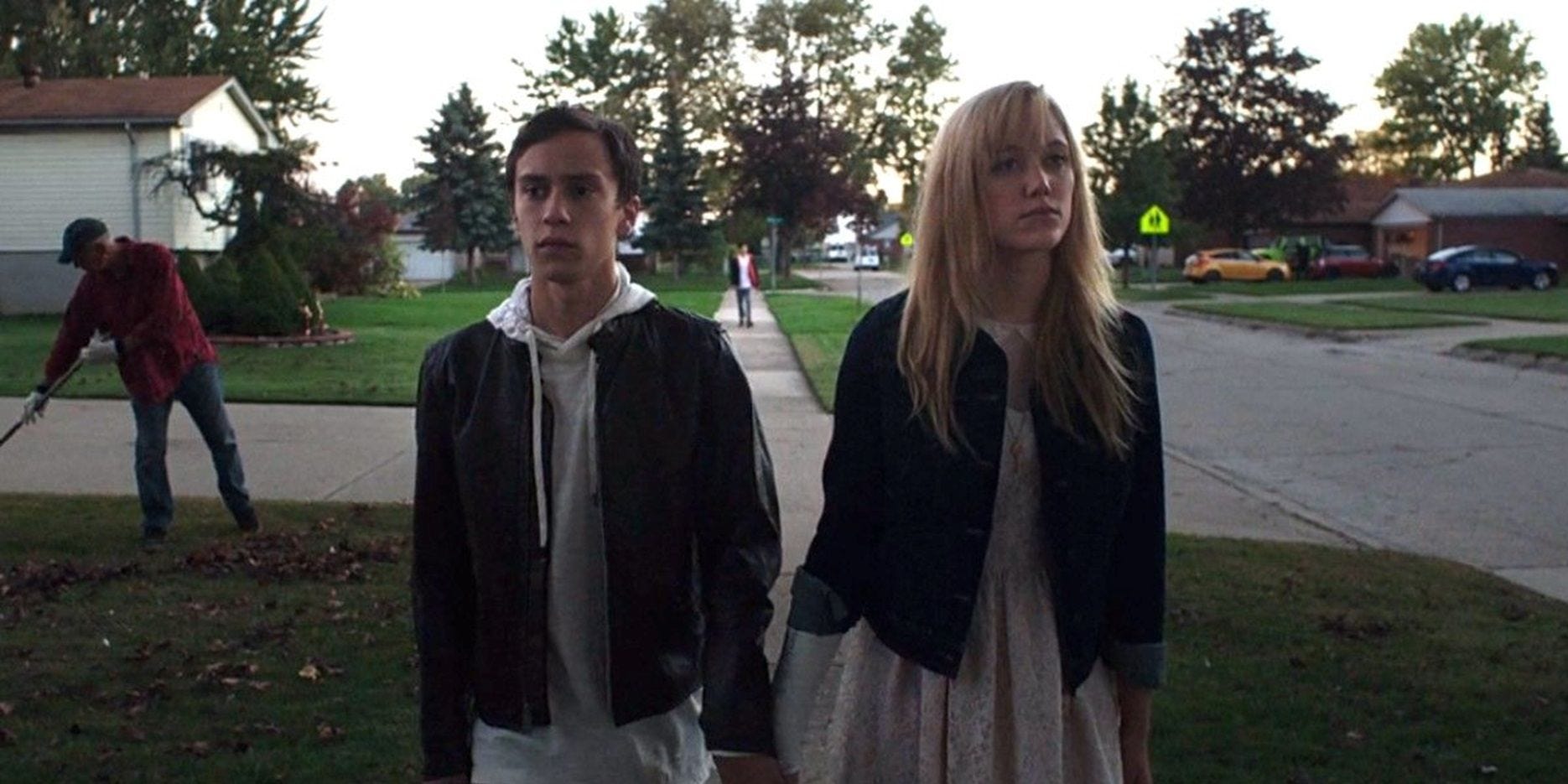
Which brings me to It Follows, a horror film that explores a lot of things, but at least one of them is investigating the unrelenting dread resulting from being pursued by an ending. In the film, Jay, a young woman becomes the target of a shape-shifting supernatural entity after a sexual encounter. This creature follows her at a walking pace, killing its victim when it catches them. The entity can look like anyone. It never stops. It can be delayed by passing the curse on to someone else, but ultimately (the repressed) always returns.

Enjoying this? Buy me a coffee?

Which makes the movie and It an eerie metaphor for Capitalism: an often invisible entity, that becomes known only to its victims (something which it bears in common with Carpenter’s They Live) and which can only be avoided by exploiting other victims in a sort of manic Ponzi scheme.

Much of the creeping fear that the movie engenders is due to Its nature. Because the creature at the movie’s core can’t be reasoned with, it has the implacable quality of a primal force. It can look like your neighbours. It can look like your parents. It wears the mask of what you know.

Like Capitalism then, the entity in It Follows demands that we keep moving and keep the questions to minimum: that we keep on running, spending and consuming. It wears us down. Slowly, quietly and relentlessly.

During the film’s finale, the protagonists try to trap the entity in a swimming pool. For a moment it appears that the gambit might have worked. Jay survives, but the final shot shows her walking away with her boyfriend while, in the background, a figure walks behind them.

The End … or is it? Mwahahaha.

That circular, open ending is one of the things that makes It Follows so compelling and disturbing to me. The curse hasn’t been ended, it’s merely been postponed, unresolved. And that feels a lot like the emotional register of whatever this thing is that we call “late capitalism”.

We’re integrated components of a system that is dizzily documenting its own demise, but the endings that we might reasonably expect: collapse, revolution and transformation never quite arrive. (For me, there’s something of a parallel here, between that bit of old post-punk wisdom that any significant resistance ultimately gets packaged up and sold back to society as a life-style.) We’re controlled by the very system we’ve constructed. Telling ourselves that there is no alternative, instead of an ending we get packaged decline, reboots and bit-rot.

This is why the term “haunted capitalism” feels a more appropriate epithet to me than “late-stage.” Capitalism doesn’t die, it persists, populated and animated by the ghosts of futures that never fully arrived: dead city centres, empty social media networks and nostalgia for discontinued chocolate bars. We’re surrounded and invested in an epistemological infrastructure that exists only as a sort of grim hangover cure.

It’s entirely possible that Timothy Leary’s exhortation to “turn on, tune in, drop out”, might be one route out of our current predicament. Not as escapism, but as refusal. As a way of unthinking the system we’ve convinced ourselves is “natural.” Most economists seem to agree that our current economic model has its roots in the changes wrought during the 17th century such as early industrialisation, enclosure and colonial trade.

So before that, there were other logics and other systems available. Not better, necessarily, but different. So Hyper-capitalism isn’t inevitable. It’s no more a function of human nature than a Saturn V rocket is a function of a matchstick.

Having fun? You could buy me a cuppa, Guv’nor

It Follows doesn’t offer a clean ending. But then neither really does Capitalism. That is its horror and its ultimate trick, teaching us to fear its (almost but never quite materialising) collapse while numbing us to the horror of the present. Perhaps, it’s more accurate to think of it as a curse that we carry, not a structure we can challenge.

So, to resist haunted capitalism, perhaps we have to do more than call it “late.” Perhaps we have to try to imagine the unimaginable: not an apocalypse, but a departure. A refusal. Maybe that is something that we as fantasy, horror and science-fiction writers can do. We can lean-in to the job of re-worlding our future. Rather than documenting dystopias we can attempt to imagine how we might finally break the curse, by envisioning a world that no longer accepts it.

Because, failing that, I don’t think there’s a swimming pool big enough.

Less something broadcast and more something that slipped through: Schalcken the Painter

“Turn from the light. Your breast bare. Look into the dark.”

I encountered the BBC’s adaptation of Schalcken the Painter one Christmas night in 1979. Looking at Wikipedia now, I can confidently inform you that it was shown under the Beeb’s Omnibus arts umbrella, part of the corporation’s a Ghost Story at Christmas tradition. Since then, it has rarely been repeated, although the BFI released an edition of the film on DVD about a decade ago which is where I rediscovered it.

But that first viewing many years ago, was part of the serendipity of the three terrestrial TV channels of the time. As a child, I’d just turn the dial to commune with the great collective unconscious in the sky and keep turning it until something found me.

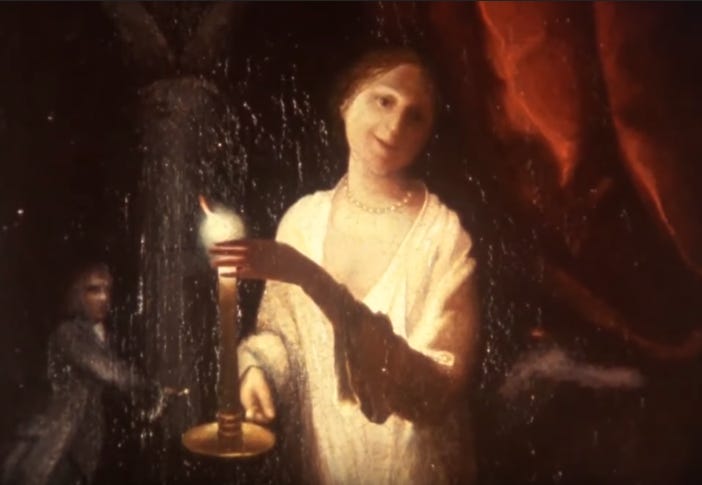
The “Schalcken” commissioned for the TV production depicting the doomed Rose and the painter in the background. Artist unknown.

Schalcken was that something. Feeling much less like a programme than something that manifested when I was up later than I should have been, it was a story beamed directly into me. Without knowing anything about it or having a copy of the Radio Times to hand, the film was charged with what Simon Reynolds might call a hauntological atmosphere, a static-tinged invocation of the past where the absence of any context felt like a presence. It was less like something that had been programmed and more akin to something that had slipped through.

The film is an adaptation of Sheridan Le Fanu’s short story of the same name. Both centre on a young Dutch painter, Godfried Schalcken, who was known for candlelit portraits of young women that were both suggestive and intimate. Apprenticed to the miserly Gerrit Dou, the story concerns one such work by the young painter. It depicts a woman carrying a candle while the figure of Schalcken himself stands behind her, sword half-drawn. A shadowy something lurks nearby.Subscribed

Narrated by Charles Gray, the film reveals that Schalcken produced the painting after experiencing a terrifying vision of his lost love, Rose, Gerrit Dou’s niece, following her marriage to an unearthly rival, Minheer Vanderhausen. After the marriage, she returns to the family home to beg for help, but Schalcken is unable to aid her. Subsequently, he becomes embittered and is ruined by ambition and regret. Cursed by strange visions of Rose’s fate, he paints the picture that is the tale’s inspiration.

Looking back now, for me the most striking aspect of Leslie Megahey’s production was its sound design. The foley work is close-miked, claustrophobic and opinionated. Coins clatter guiltily. Mealtimes are a medley of scraped cutlery and clocks ticking. Above all, the ghoulish Vanderhausen is introduced by a subtle creaking cue and a basso throb.

Maurice Denham is at his gnomic best as the acerbic Gerrit Dou. (Setting up one scene for his students, he dismissively indicates his two models: “St Anthony. Temptation. Devils … you will imagine the devils”). Jeremy Clyde’s Schalcken is at once amoral and careerist. Cheryl Kennedy’s Rose is, alas, little more than a human plot point. And there is something magnificently ghastly in John James’ monolithic Vanderhausen.Subscribed

Many of the film’s scenes are painterly tableaux that echo the Dutch Masters. They are composed as slow, locked-off shots demanding attention and suggestive that things are happening just outside their frame. The overall pace is profoundly mesmeric. As a kid who revelled in the reckless blood-spurting, page-turning chaos of 2000 AD, the film’s sense of stillness was agonising and compelling.

If Le Fanu’s original tale is a masterful example of gothic grimoire, Megahey’s adaptation is more satisfyingly grounded and disturbing, I think, in that it explores aspects that the source material only hints at. Namely, the commodification of the erotic, the sex worker economy and the casual treatment of Rose as an object for sale to the highest bidder, in this case the eminently unsuitable Vanderhausen.

Encountering this film without any context made it all the more unnerving. Lacking much to orient me, its docudrama approach, unsettling atmosphere and languorous sense of dread were perfect. But I do wonder how much of its impact was a function of the way it found me, free of frames of reference or any sense of what it was.

A perfect example, perhaps, of the uncanny as a format rather than a plot, its final few scenes lurking in my memory for days after I saw it and still capable of evoking a sense of dread years later. But that mood lay not only in the tale itself, but in how it arrived, formally unplaceable, aesthetically estranged. Schalcken the Painter wasn’t just uncanny in content. For me, bathing in the flickering TV light that night, it was the uncanny

Years later, I rediscovered the film and watching it now, it’s still chilling, but since I know so much about it, its sense of dread has receded. Knowledge of its origin has dispelled its hauntological charge. That notion I had of not-knowing, the feeling I was watching something that might be forbidden has faded, taking with it the creeping sensation that instead of a slightly hokey Christmas ghost story, I was witnessing a transmission from the outside.

My weird fantasy debut The Lighthouse at the End of the World is published by Titan Books April 2026. Pre-order it here.

Questions for this issue:

  • I’d love to hear from anyone else who has encountered the uncanny as format?

Playlist

  • You can hear Sheridan Le Fanu’s original gothic tale read by the wonderful Ian McDiarmid here.
  • Watch Leslie Megahey’s the adaption here. You’ll need to login due to age restrictions (there is some nudity, well, it was the 1970s). The reproduction is low quality, although IMHO that only adds to its atmosphere.
  • The BFI’s Graham Fuller analyses the film: https://www.bfi.org.uk/features/why-i-love-schalcken-painter
  • You can buy the BFI DVD edition here. Apologies for the Amazon link but the BFI shop seems to be closed right now.