Lost horrors: how the eerie telly of the 1970s birthed liminal dread

Or: if you’ve got no budget, chuck in a corridor

The liminal is always there, waiting for us. That empty classroom, quiet after all the kids have gone home. The cracked tarmac of the car park late in the afternoon. Any hotel room ever. In any hotel. All deserted, but freighted with presence. The liminal can always wait us out. It has nothing, but time on its hands.
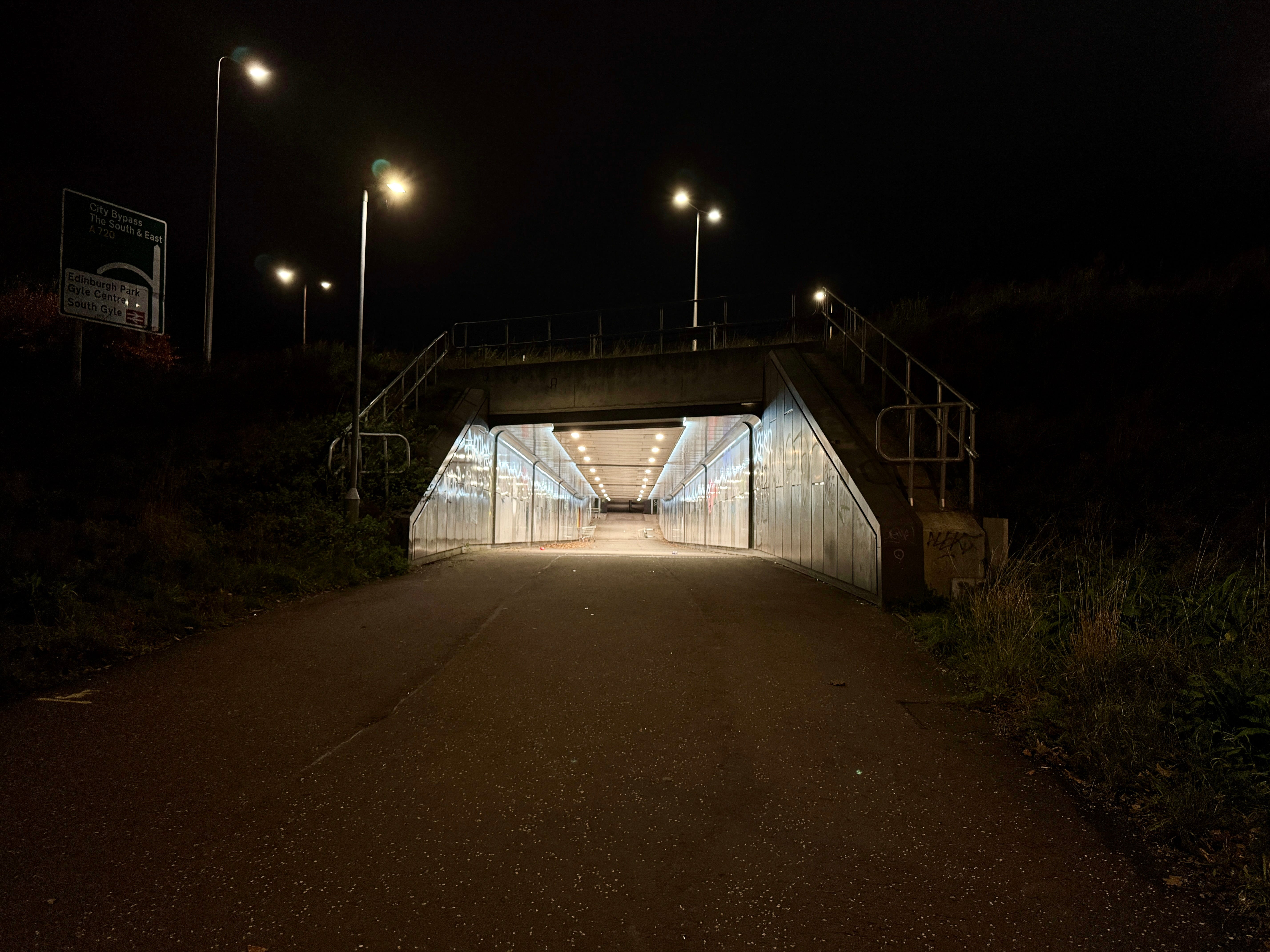
The liminal as an aesthetic is everywhere now. Just look at Apple TV’s hit show, Severance, which builds an overbearing sense of anxiety through (among other things) the use of oppressively indistinguishable office spaces. Or the neo-retro bureaucratic vibe of Marvel’s Time Variance Authority.

Looking at my own work, I love nothing better than an empty stretch of torn up concrete, a relentless corridor or a dead beach full of office furniture. And I think my interest in these things is a product of the period I grew up in.

Reality was spongy underfoot in the mid-seventies. The high price of oil meant that there were power cuts and a three-day week. Regional magazine programmes regularly ran segments on the paranormal. Cursed objects, werewolves and vampires may have been reported in a gently mocking style, but their irony wasn’t something my kid brain could parse. If something was on a news programme that meant it was “real”.

That’s before we even look at some of the programming intended for children back then. As Richard Littler, creator of Scarfolk puts it, we were, “a generation … glued to the TV, exposed to a world where much of what [we] saw seemed slightly unhinged.”

The cultural theoretician and de-facto hauntological-cult-leader, Mark Fisher has already pointed out just how strange ITV’s paranormal science-fiction programme Sapphire and Steele was (and remains). But this was just one show among much odd programming that generated an appreciation for the eerie in the kids watching it.

The Changes in whose first episode, a family, (complete with pipe-wielding dad), completely lose their shit and smash every piece of technology more advanced than a candlestick was deeply disturbing. Equally unsettling were the undiluted folk-horror weirdness of ITV’s The Children of the Stones which portrayed a village locked in a brainwashing psychic time-loop or the creepily inappropriate adaptation of Alan Garner’s The Owl Service, where the underlying sexual charge of some scenes make it an uneasy watch today.

The subtext of many of these programmes can probably be generalised as a recoil from modernity, but shopping for candles with my mum made me feel that modernity, at least as I understood it at the time, seemed to be recoiling from us. These were programmes that gestured toward the grown-up world, while also heavily implying that adults didn’t have a clue about what was really going on. We all sat around the flickering TV set, waiting to be plunged into darkness by the next power cut.
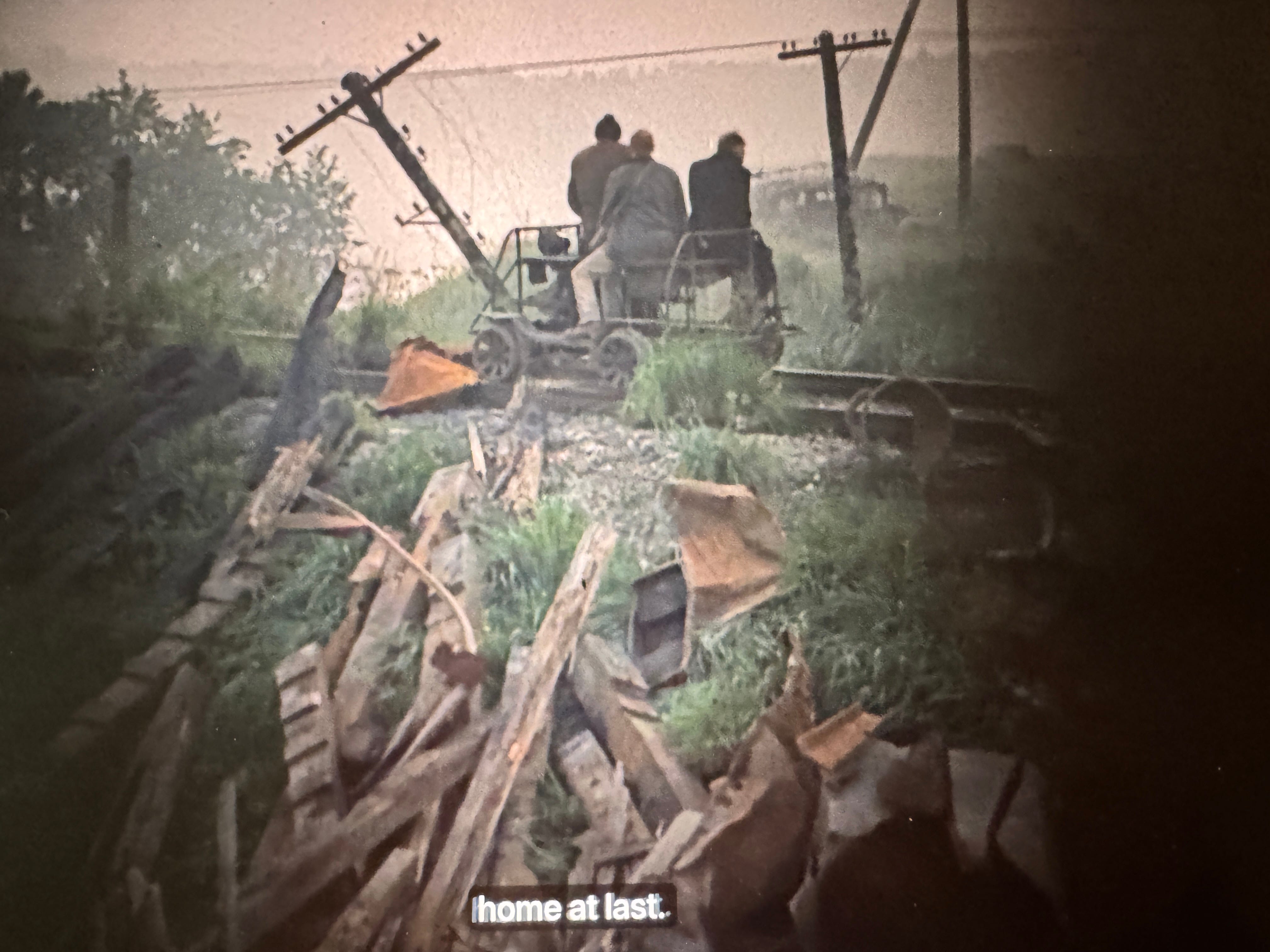
“Home again, home again, jiggity jig.” Tarkovsky’s Stalker

While much of the eerie charge of these programmes was a product of their time, the cheaper-than-thou production costs and the limits of seventies special effects meant much had to be evoked and little shown (similar to the approach of Tarkovsky’s ‘Stalker’ were the uncanny mood is established, mostly, through performances, music and dialogue). The net result is a lurking sense of lack, reminiscent of Fisher’s ideas about how the eerie arises from some types of absence. To me, the scariest parts of the BBC’s mythic MR James adaptations were always the long tracking shots of the misty East Anglia coast rather than spectres swaddled in bedsheets.

But this form couldn’t really survive exposure to Thatcher’s Britain of the 1980s. Brightly lit, in primary colours, the eerie never stood a chance against Wham! shoving shuttlecocks down their shorts. Perhaps, nothing represents this shift better than the way Dr Who’s hauntingly wheezy Ron Grainer/Delia Derbyshire analogue theme tune was replaced by a mid-80s farting synth score.
Despite this particular brand of eerie evaporating, it did leave a psychic imprint: a sensibility characterised as an anxiety for what might be shown rather than what was. It primed my generation, I think, making us receptive to the sinister languor of Lynch’s mirror-universe Americana; checked us all into Kubrick’s Overlook hotel and sat us down in front of a TV tuned directly into the signal from Cronenberg’s Videodrome. These three directors, for me, really take the wobbly-set principles of cut-price British telly and formulate it into a coherent aesthetic of the uneasy.

The creepy-as-fuck Tommy-cam shots of the Overlook’s corridors, build an almost unbearable tension. Similarly, Lynch’s opening shot in Blue Velvet gives us an idealised suburbia complete with a white picket fence, before slow dive zooming, to reveal the insect life that roils in the lawn grass. Cronenberg’s opening in Videodrome announcing CIVIC-TV as, “the one you take to bed with you” perhaps suggests something even more transgressive and intimate, a merging of the body and the broadcast.

It’s tempting then, to consider these as the flip side to French theorist Jacque Derrida’s ‘lost futures’ of hauntology: the idea that our current cultural stagnation (witness conveyer-belt reboots and IP freighted properties) is a result of our inability to escape the nostalgia surrounding the futures we were promised, but which never arrived. Here though, the eerie spaces of the liminal evoke something new, something more akin to lost horrors.
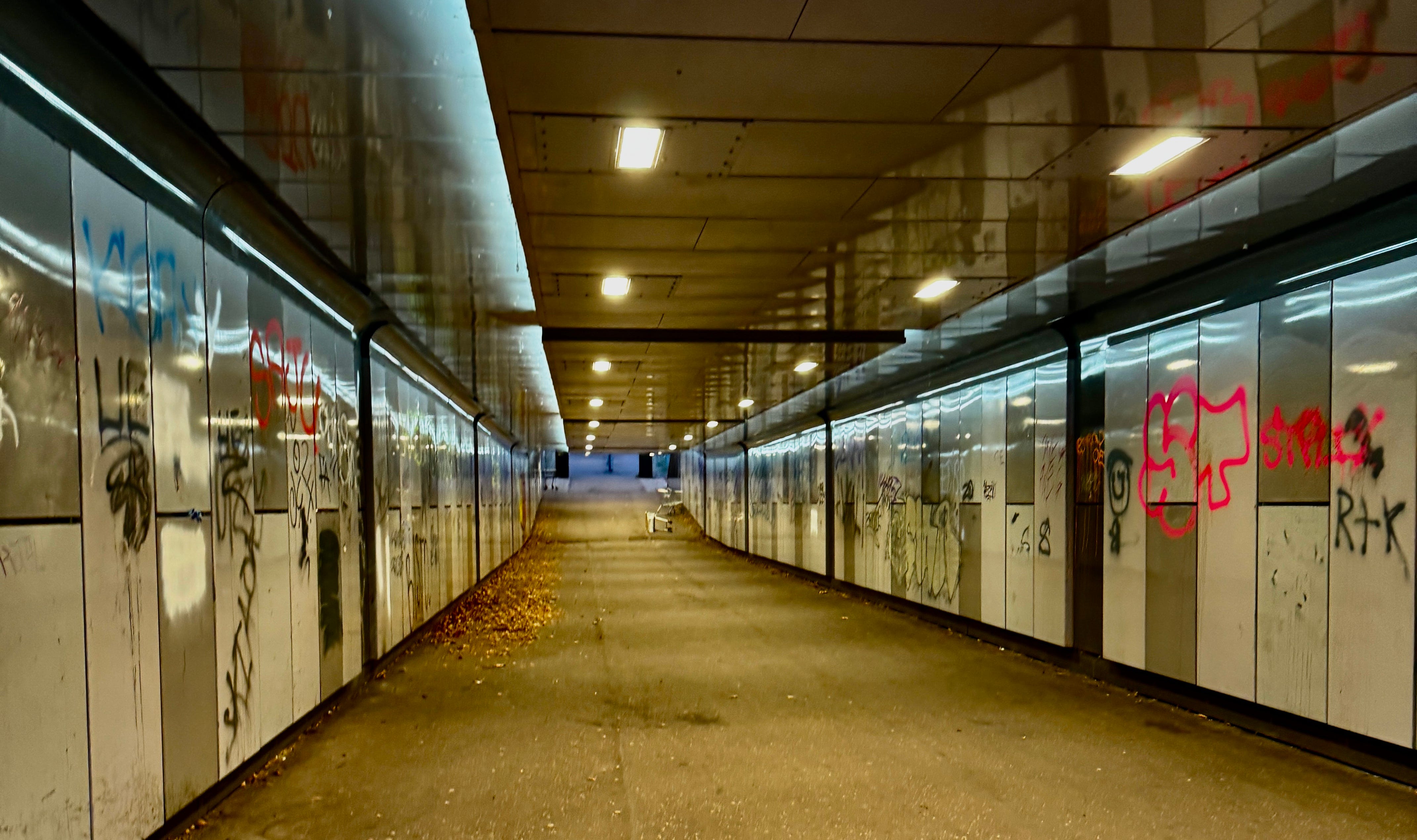
I would argue, that while mainstream culture might be locked into an endless rinse-repeat cycle, these sensibilities have seeped into online culture to generate real innovation. The unease aesthetic is the basis for the crowd-sourced horror of creepy-pasta, the liminal crap-office creepiness of the Backrooms or the cheap-as-chips-and-twice-as-daft scares of Life of Luxury, where internet influencer culture meets mid-west subprime-mortgage horror. These are the nightmares dreamed by the children of the “New Flesh” and ARPANET.

Given all this, it’s perhaps no surprise that the London I portray in The Lighthouse at the End of the World is full of edge spaces. It’s Donald Pleasance’s “Lonely Water” voiceover at 3AM in that waste ground where the council stores the bins. These were the spaces I played in as a kid. The equivalent to the modern digital eerie, where bots shit-post each other on the dead internet and ghost sites crumble from bit rot.

My book is not a horror novel in any real sense, but it’s built on the foundations of the liminal. Its antagonist, Mr Primrose, has a deep understanding of thresholds and how the eerie emerges from them. He uses this knowledge to manifest on bridges, tower block roofs or the concrete gloom of a business park. He understands it’s a texture woven into the torn-up tarmac and the shredded weeds. You can always find it at the edge of things, if you know where to look.

And that seems only as it should be.


A version of this essay was first published at Ginger Nuts of Horror which I heartily recommend. My debut fantasy novel, The Lighthouse at the End of the World, the first in the Cities of the Drift series is out now from Titan Books. You can purchase it here.
monsters

I have a guest post over at the Barnes and Noble Reads blog on the subject of monsters.

“I love monsters.

But what makes a good one? For me the definition is it’s a category error. Something that, no matter how hard you try, won’t conform to the boxes that make up your mind (well, my mind anyway). The creature in Frankenstein is a classic example. It lives but is stitched together from bits of dead things.”

You can read it in full here:

https://www.barnesandnoble.com/blog/philip-a-suggars-guest-post

My debut “The Lighthouse at the End of the World” has been selected as their speculative fiction pick for April 2026 and is currently in their list of paperback bestsellers.

You can purchase it from them here: https://www.barnesandnoble.com/w/the-lighthouse-at-the-end-of-the-world-philip-a-suggars/1147793854?ean=9781835412497

this is not a newsletter*

*Oh yes, it is.

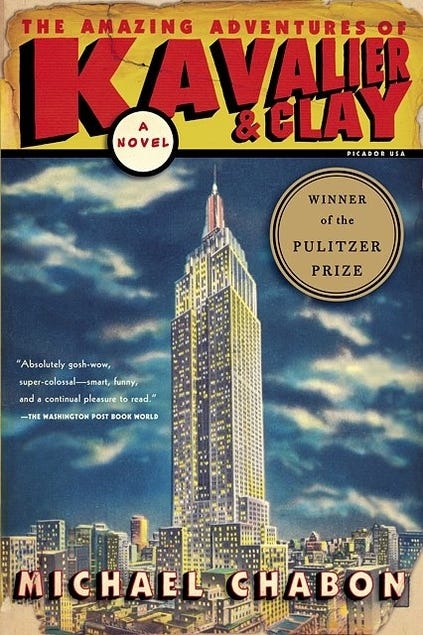
About fifteen years ago, I was in mid-town Manhattan standing in the monolithic Barnes and Noble on Fifth Avenue. I’d not long had my first short story published. I’d just bought a copy of Michael Chabon’s wonderful Kavalier and Clay and I remember, idly daydreaming that my own book might be in that book store one day (although at this point, I hadn’t written anything much longer than a shopping list.)

The Amazing Adventures of Kavalier & Clay by Michael Chabon | Goodreads
If you haven’t read this … then you probably should.

Weeeell. I’m as statistically sure as I can be (without getting actual documentary evidence) that that has now happened. 

Achievement unlocked. 

So, The Lighthouse at the End of the World, has been out in the world for about three weeks at this point. As you might expect, this is a strange and (mostly) wonderful thing. I think, I’m just about beginning to get my head around it. 

At the very least, the next time I’m at a literary cocktail party (of which I attend oh-so-very-many) and someone asks, “have I read anything of yours?” I can just point them at Barnes & Noble or Waterstones. 

When the book came out in the US at the end of March, initially, it felt a little abstract. I knew this thing was out there, a stack of papery objects with my name on, about three-thousand miles away on the other side of an ocean. It was a slightly unreal, almost uneasy, feeling.

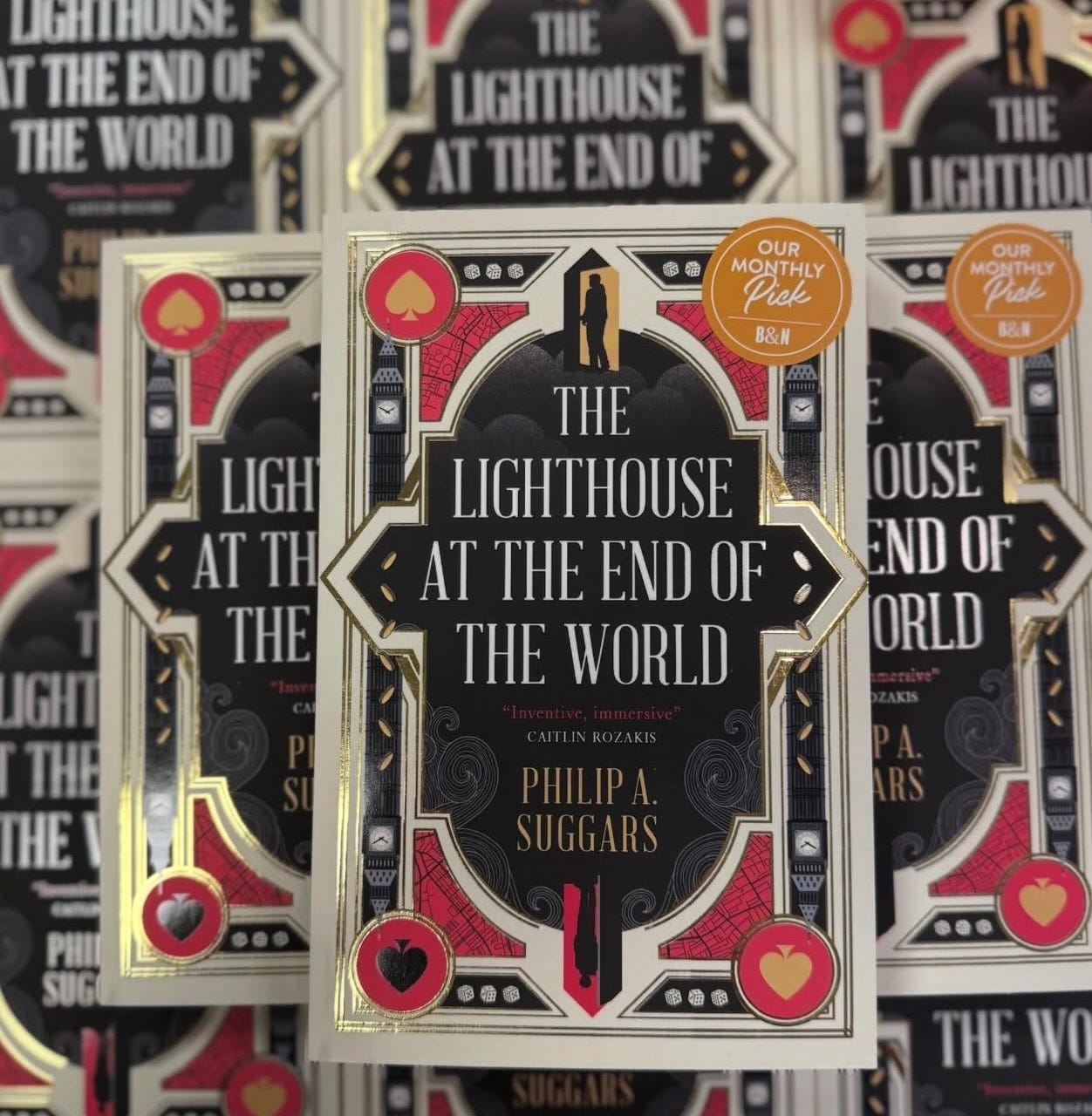
Then, the managing editor at Titan wrote to me, to tell me that The Lighthouse at the End of the World had been selected by Barnes and Noble as their speculative fiction pick for April.

A graphic advertising The Lighthouse at the End of the World as Barnes and Noble's speculative fiction pick for April 2026

Publishers are at pains to keep this sort of information completely under wraps, so the cheeky sods at Titan had kept this secret until the day after the US release. To say I nearly fell off my chair is an understatement. 

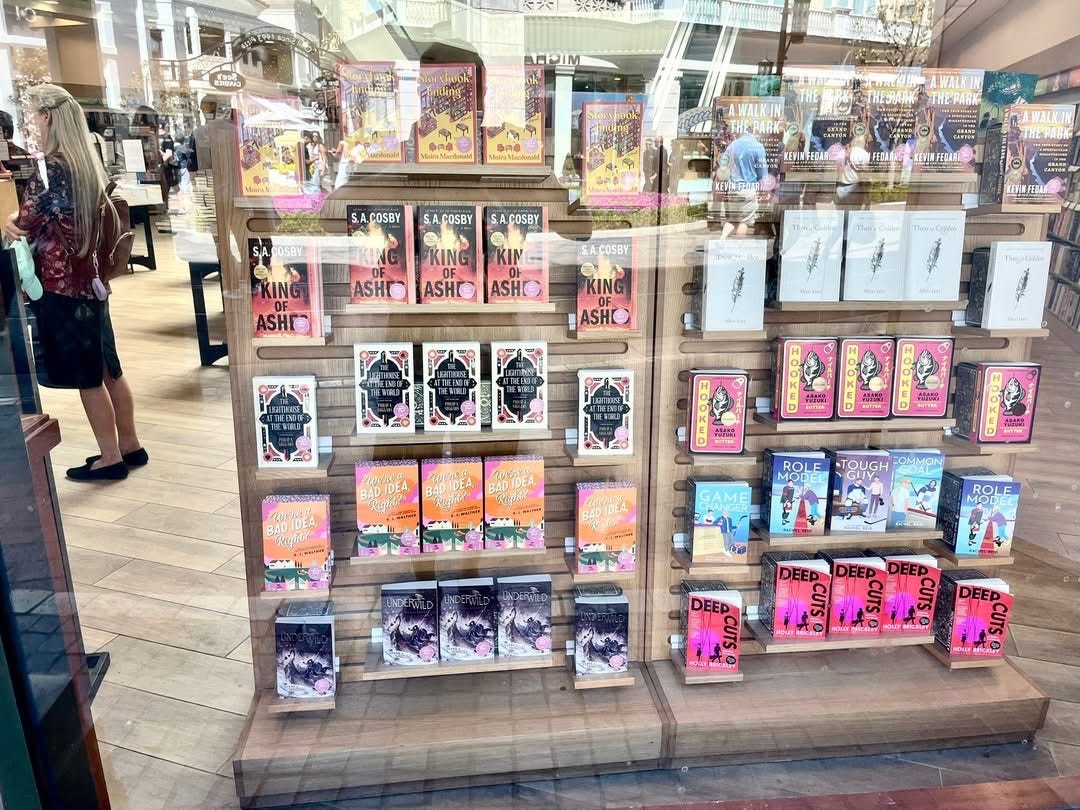
Even so, it did still feel oddly academic until a day later, when I was queuing in the local Londis to buy a pint of milk. A friend of mine based in LA sent me a photo of my weird little tome sitting in the front window in one of Barnes and Noble’s Hollywood bookstores. There it is in the picture below, third row down. 

If you’re a mouthy kid from Tooting (and I am), that is a pretty surreal moment. 

Window display at the B&N in The Plaza, LA

So, the last three weeks have seen me trying to keep up with publication day without totally losing my shit: 

  • An interview with Jim Mcleod at Ginger Nuts of Horror. Despite its brilliantly facetious name, this is a really cool site that takes its genre fiction (not too) seriously. 
  • A guest post on the subject of Monsters at the Barnes and Noble reads blog.
  • Appearing at Super Relaxed Fantasy Club in London on 14th April. This is a very friendly meet-up for London-based fantasy fans and happens on the second Tuesday of each month at the Star of Kings pub near Kings Cross. Events are advertised on this Facebook group and consist of a couple of authors doing readings and interviews. The vibe is very low-key and friendly, I really can’t recommend it enough, if you happen to be in the area.
  • A conversation with Derek Tyler Attico for the Soul of the Story podcast on the SyFy Sistas YouTube Channel. Derek is a lovely person who I met at Worldcon a couple of years ago. He’s a consummate podcast host, brilliant writer in his own right and a pretty passionate Star Trek fan to boot. (He wrote The Autobiography of Benjamin Sisko for Titan). 
  • In addition, I’ll be appearing at MCM Comic Con in London on Saturday 23rd May @ 2pm on the Debut Author Experience panel. Do come along and say hi, if you happen to be at the event. I was at this last year with my daughter as a punter and so getting to be on a panel here is amazing, strange and humbling all at the same time.

Generally, I’ve been steering well clear of reviews. Not because I’m an ego-crazed narcissist tyrant who doesn’t want feedback, (does two out of three count?) Rather, I really don’t need any extra brain-weevils in addition to the ones I’ve been blessed with kicking around in my head while I’m writing. 

That said, here are a couple that my agent has cast in my direction. 

Generally, I’ve been delighted with the book’s reception and Mcleod’s conclusion that “this is British speculative fiction doing something different” is the sort of capsule review that I want tattooed on my forehead. 

It’s odd now to think back to all that time ago when I was in Manhattan. I hung around Brooklyn hoping to bump into Paul Auster doing a cigar run. Alas, that will never happen now, but at least I might be in the same bookshop as him. And that feels like something to celebrate. 


My debut fantasy novel, The Lighthouse at the End of the World, the first in the Cities of the Drift series is published by Titan Books. You can purchase it here.

policing perception: weird fiction, the Gutenberg Parenthesis and the warped borders of the real

There’s a moment in the Wachowski’s seminal 1999 movie the Matrix where Keanu Reeve’s elegantly blank Neo sees the same black cat walk past a doorway twice. In the movie, such moments are signals that the nefarious Agents are about to emerge into Neo’s simulated reality and give him the mother of all cardio workouts.

Woah! Déjà vu, dude.

But what if something similar were to happen to you?

Perhaps you have a similar moment of déjà vu, notice that roses now seem to smell like freesias or that the sky suddenly looks a bit purple. Everyone you tell about this discovery, however, insists that everything is the “same as it ever was” (in the words of the old song). Roses smell as sweet. The sky is the same old blue.

Perhaps after a while, you might accept that it’s your perception that is at fault, shrug a little and decide to get on with the gardening. But at the back of your mind there might be a nagging doubt. Perhaps you were never supposed to notice the difference.

This is the terrain of the weird. Not quite full blown fantasy, but the quiet unease that things might not be quite right. A sense that the ground beneath your trainers might be a little less solid than you previously thought.

Few books map out this territory more ingeniously than The City & the City by China Miéville or The House on the Borderlands by William Hope Hodgson. Both of these novels deal in epistemic slippage, the boundaries of what is knowable and what is known, (what Miéville himself has referred to as “sublime backwash”). Each exists though at the polar opposite of the other. Where Miéville presents us with a world where the epistemological structure is brutally policed, Hope Hodgson describes a universe where there is absolutely and gloriously no epistemological structure whatso-fucking-ever.

In Miéville’s murder mystery, Inspector Borlú a policeman from the city of Besźel investigates a murder that requires him to work with a partner in the twin city of UI Qoma. Nothing too odd there you might think, except for the fact that the two cities share much of the same physical space. In order to maintain the illusions of separateness and sovereignty, citizens of one city must “unsee” anything pertaining to the other, ignoring people, buildings and even events that occur right in front of them. Failure to do so results in an intervention from the shadowy and terrifying force known as Breach.

Treated with a near mythical dread, Breach, disappear any violators or evidence of transgression, maintaining the ideal of separateness. They have an almost supernatural ability to detect and punish any infractions and in many ways function much like the Agents in the Matrix. They’re spectral, terrifying antagonists who are rarely perceived and cannot be beaten. Only they have access to the duality of the world as it is and as it is perceived.

One of the brilliant things about the novel is that crossing between the cities is a bureaucratic activity. Visitors must queue up to pass through a universal access point, Cupola Hall, filling out forms and editing their perceptions as they go. (Imagine entering Narnia via passport control.) Breach, then, isn’t just a surveillance force, it’s the living embodiment of the Gutenberg Parenthesis: the period between the rise of print and the digital age, when truth was shaped by centralised, text-based notions of authority.

Now, let’s flip this on its head.

Never fails.

In House on the Borderlands, if there is an equivalent of Breach they’re all out for coffee and donuts. Within the book’s framing narrative, an old man dwells in a remote house that seems to be perched precariously on the edge of space and time itself. Violent swine-things emerge from the wilderness and attack him (and his dog!). A pit opens into infinity. The house falls into disrepair as does reality itself. Time speeds up and slows down and the old man sees the solar system wither and die, meeting with the spirit form of his lost love in the process. (Clearly, the cosmic horror equivalent of drunk-texting your ex).

Here is a world without perceptual control. Consequently, the old man witnesses everything, including the heat-death of the Universe and it does him in. There’s no central authority to frame events, no system to structure reality, everything is in a state of turmoil and collapse.

It’s easy enough to see the connection here. Both novels dramatise the opposite ends of the epistemic spectrum. In The City & the City Borlú experiences the effect of a suffocating truth apparatus: ultimately you-can-only-see-what-you’re-allowed-to. In The House on the Borderlands we get a peek at what happens when no-one is in charge, not even reality itself.

It’s fair to say that we’re somewhere in the middle of these two extremes right now, that the five hundred years or so since the invention of print has been the equivalent of sleeping on Borlú’s sofa: uncomfortable, but still governed by house rules. We got verifiable truth, experts and certified sources. (A Breach of sorts also, perhaps). But it’s hard not to feel that that period is coming to an end, that while we were sleeping the internet and digital culture pushed our bed into the old man’s house on the edge of the abyss.

What is clear here is that command of the truth equates to political power. Breach wouldn’t be able to exert its control without the compliance of the citizenry of Besźel and UI Qoma. In the House on the Borderlands human history (and, ergo, all politics) is vapourised against the sheer scale of cosmic time.

But noticing that shit-gets-strange is not the same as deciding that the moon landings were faked, or that JFK was an alien. Engaging with the weird isn’t a call to relativism or an embrace of conspiratorial thinking.

There is a philosophical and moral distinction, I think, between questioning the framework and denying reality itself. While the weird draws attention to how things fit together (or not) and why, it is not an invitation to retreat from the rational. Rather, it should encourage us to ask how the rules around truth are made, who enforces them and what happens when they falter.

In world where politicised digital culture exhorts us to pick a side, the blue pill or red pill perhaps instead we should be asking: where did these pills come from? And who’s interest does it serve to keep us squabbling?

Or as Tony Benn once pithily framed it :

  • what power have you got?
  • where did you get it from?
  • in whose interests do you exercise it?
  • to whom are you accountable?
  • and how can we get rid of you?

If “doing your own research” simply means finding other people on the internet who already agree with you then I humbly submit you’re doing it wrong. Each one of those bits of confirmation bias edges us closer to the old man’s pit and the swine-things.

So we carry on watching the sky. And if it seems a bit too purple, maybe we don’t insist it’s blue out of habit or call it green out of spite. We just keep looking, keep asking and perhaps resist the pressure to unsee.

playlist

My fantasy debut: The Lighthouse at the End of the World from Titan books is available for preorder now.

cover story

One of the things that is true for most of the writer-types I know, is that we care quite a lot about the covers that wrap our words. I mean, stating it now, it seems totally freakingly obvious, but that old saw about “not judging a book by its cover” suggests that if you are the-sort-of-person-who-does-care-about-that-sort-of-thing then perhaps you might be a bit superficial.

Okay then …

I am a lot superficial.

Looking over my contract with Titan Books I saw that it promised that I’d be “consulted” on the cover for Lighthouse at the End of the World, although “consulted” does feel rather like a weasel word which might shield any number of sins.

Over the years, I have met writers with cover horror stories to tell. Covers that were so anathema to their original intent that recalling them still brings salty tears to their sweet, sweet eyes.

Equally, I am aware that we writers (present company accepted obvs) can be an egotistical bunch of awkwards who feel that nothing short of gold leaf and vegan leather are suitable containers for our genius. So, it was a nice surprise to get a note from my editor last month to say that he would be sending over a few potential covers for consideration. (This is actually my first rodeo – as the t-shirt says so I wasn’t sure what to expect.)

The four options that materialised in my inbox a couple of days later were all brilliant in their own ways and each one thrust a sturdy finger into the eye of the all too common contemporary practice of asking AI to puke up some generic bollocks with wizards on it. (I do appreciate that I am privileged in this regard, but come on people!)

I’m happy to say that the process of going through them was incredibly consultative with a lot of back and forth between me, my agent, my editor and the design team, to determine which would work best. Once that choice was made we went through a few iterations to get it was just right.

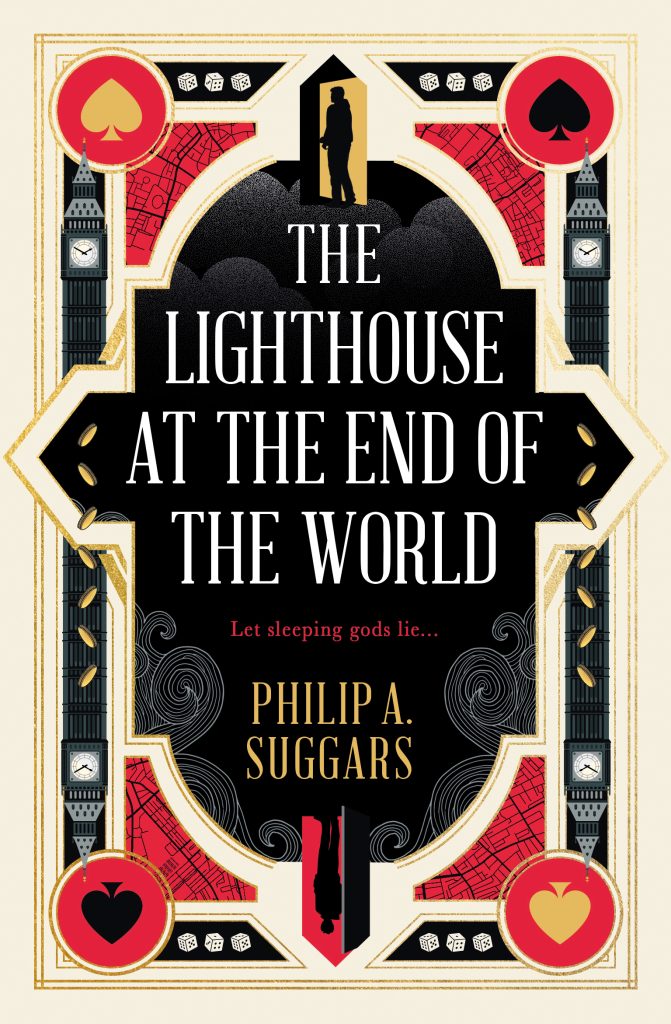
And so I’m very pleased to be able to share the final version in all its glory, as revealed on the ReactormagSFF site on the 30th April, along with a neat one sentence pitch:

Enter a London like no other in this fast-paced, captivating fantasy novel filled with warring gods, alternate realities and a working class kid caught in the middle of it all…

Hope you’ll agree it’s gobsmackingly gorgeous. I couldn’t be more pleased. Thanks to all the wonderful peepage at Titan Books for their patience and hard work in developing such a great cover. (Although, if there is a gold leaf and vegan leather option perhaps we can explore it?)

Finally, if I may be so bold, preorders really do help a book release land, so if you feel that The Lighthouse at the End of the World might be up your alley, you can preorder it here.

bsfa best fiction long-list: good vibrations

I’m delighted to announce that my story good vibrations, published by the mechanics institute review last year has been long-listed for the bsfa best short fiction award.

bsfa logo

You can read the story here and see the full longlist here.

hulk is tired

I’m not exactly sure when it happened, but I think I might be a bit bored with speculative fiction. Or perhaps, speculative fiction is a bit bored with me.

Could it be that we’ve just been seeing too much of each other during lockdowns one through three?

“It’s not you, it’s me,” spec-fic might say on our regular date night held in the corner of a friendly tavern (built beneath the shadow of towering rocket-ship).

Certainly, I seem to have read a lot of speculative fiction lately that simply moves the genre furniture around the house rather than adding a new wing (or preferably) trap-door to it.

It’s a thought that reminds me a little of what Robert Eaglestone thinks is genre’s birth defect. For him, literary fiction is really where it’s at.

“It says everything,” he says. (Which is the whole point apparently.)

From his perspective, genre fiction, too-often, is only ever talking to and about itself.

And while I think this observation does articulate some of my own weariness, how to square this with his rather contradictory special pleading for lit-fic itself, which he regards as a non-generic type of writing whose tendency to be in conversation with its own history is validation of its uniqueness rather than a flaw.

As an aside, I wonder if beneath some of the slightly sniffy attitudes expressed towards spec-fic in literary circles lies the fact that it often sells a lot better than literary fiction.

Having all that filthy lucre smeared over your tentacles means that genre
cannot be art at all, rather it is something commercial, hybridised and
degraded. That said, Dickens and Cervantes both turned out contemporary
best-sellers and you can’t get much more canon than little Davy Copperfield or the Madman of La Mancha. (It’s possible then, that perhaps critics will even regard Stephen King a little more kindly in a hundred year’s time.)

So, I’m not entirely sure where this slightly circular and self-indulgent post has got me.

Perhaps, I should start seeing other genres?

I’ll be honest about it with speculative fiction. We’ll go to the usual place on date night, drink half a bottle of chianti and work out some ground rules. Without them, in this sort of situation, someone will always get hurt. (Most probably be me.)

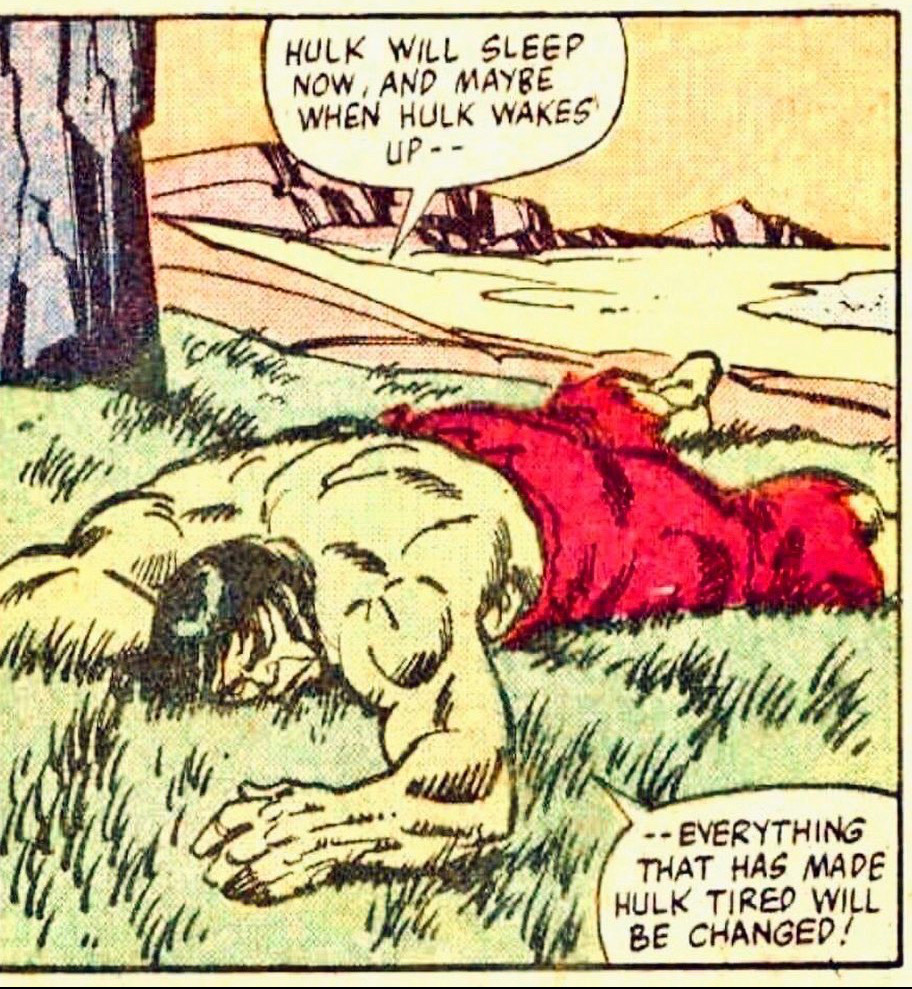
Or perhaps, after all, it really is just as the picture below says: Hulk is tired and Hulk should have a nap.

Image of the hulk sleeping. “Hulk is tired.” He says, “Hulk will sleep and everything that has made Hulk tired will change”
Hulk is really tired.