Re-run of the Repressed

or why every franchise monster you’ve ever loved ends up as a dog on a leash …

[Contains mild spoilers for Alien: Earth, Halloween, Friday the 13th, My Bloody Valentine and A Nightmare on Elm Street]

The idea for this issue has been gestating in my chest ever since I watched the last couple of episodes of FX’s Alien: Earth series, so look away now if you don’t want any spoilers.

Jeri the synthetic Xenomorph from the 1994 Dark Horse limited series Aliens: Stronghold by John Arcudi and Doug 

In those final episodes, as Wendy and the rest of the Lost Boys assert their autonomy to escape Prodigy control they wind up recruiting a Xenomorph as a sort of acid-breath-Lassie that comes at Wendy’s call to tear their corporate henchie pursuers into dog food.

What this series really crystallised for me was the way that in any long running horror franchise there is an almost inevitable slide towards the domestication of the monster. Something which begins as pure unbridled terror, always seems to end up completely defanged: a pet.

But to work out why something isn’t scary anymore perhaps we have to explore what made it scary in the first place.

How horror gets horroring

In terms of scare factor, or the horror affect, there are two main theories and they both begin with Freud. I think most people these days would agree there’s probably quite a lot wrong with Freud, but his concept of the Uncanny outlined in his 1919 essay ‘Das Unheimliche’ (the Uncanny) is quite a useful jumping off point for this discussion.

In this essay Freud defines the Uncanny as, “that class of the terrifying which leads back to something long known to us, once very familiar”.  Heimlich means something that belongs to the house, familiar and intimate, but can also mean concealed, kept from sight or withheld from others. Consequently, Unheimliche describes something eerie and frightening. Something that was intimate, hidden and/or buried but which is now revealed. The unexpected and terrifying return of that which has been repressed. 

The Shape A.K.A. Michael Myers … Bill Shatner at his most cutting

Years later in his seminal essay for Film Comment magazine, “The Return of the Repressed”, Robin Wood used this psychoanalytical framework to explore how movie monsters can be read as the reemergence of what society represses in order to function. Specifically (but non-exhaustively), female sexuality, threats to the nuclear family, questions of race, class and heteronormativity.

The evidence seems hard to argue with. Taking these one by one, readers will be only too familiar with the “horny women die first” or “sex signals death” trope. This can be seen in the opening of Friday the 13th, the death of Tina at the hands (talons) of Freddy Krueger in A Nightmare on Elm Street (1984) or the gruesome end of Mike and Harriet in My Bloody Valentine (1981).

Freddy also maps to the idea of parental sin (in this case he really is the return of repressed familial guilt), while Night of the Living Dead transforms racial violence into stumbling disinterred flesh. Frankenstein’s creature and Jason Voorhees, both throwaway children, are proxies for the dispossessed underclass and finally, homoeroticism and inversion of the family are common themes in many vampire movies.

As Wood points out, each of these films present opportunities for society (ie the monster’s victims) to attempt to deal with the repressed that the monster represents. In what Wood terms reactionary horror, victims must return to the bounds set by society (ie “good values“) in order to banish the threat (A Nightmare on Elm Street, I’m looking at you). In more progressive films (e.g. the original Night of the Living deadand The Texas Chainsaw Massacre) the underlying injustice/original sin must be exorcised before the status quo can be restored (at least temporarily).

Weird be getting weirder

But not all horror seems to work this way. Mark Fisher uses his book The Weird and the Eerie (2016) to suggest that there is another category of monster altogether: those threats that are ontological, that is to do with the nature of being, rather than merely psychoanalytical. For him, something like Lovecraft’s cosmic horror or Carpenter’s The Thing are eruptions into human reality of “the outside”. 

Where the psychoanalytical uncanny can be said to make the familiar strange, these xenosemic horrors introduce the genuinely untranslatable. The term (from xenos, foreign, and sema, sign) describes monsters that operate outside human symbolic systems entirely. In contrast to hidden meanings that are uncovered, these are meanings that were never human to begin with. 

If all monsters are scary because they function either as something which has been hidden through repression or something that is totally outside human meaning, then both are essentially categories of the unknowable “other”. Given this understanding it’s possible to see how successive franchise outings tend to cancel this out.

Phase 1: eruption (“I admire its purity”)

In this phase we get the monster as its purest manifestation of “the outside” or “the repressed”. 

If we think of the original Alien, the title tells us everything that we need to know about the eponymous creature. Back in 1979 there were no taxonomies, it was just “that goddamn thing”. Much of its horror derived from its unintelligibility. 

Similarly, Michael Myers was credited as just “the shape” in his inaugural outing and described as “purely, simply, evil,” by Doctor Loomis, the psychologist who treated him for years. Myers’ fixation on Laurie appears to have no logic or motive. (In fact, Myers is an interesting example of an entity that sits within both of the categories we’ve defined here. Although he’s positioned as the return of repressed familial violence, he functions in the film as a kind of xenosemic intrusion, in that he is both motiveless and essentially unkillable.)

Freddy Krueger for his part is at his most psychotically primal in, A Nightmare on Elm Street. Returning to the notion of the Unheimliche, he inhabits the most familiar and intimate place that his victims should be safe within, their dreams. In NightmareFreddy hardly speaks at all, and while an origin story exists, the film itself doesn’t explore it. 

Phase 2: codification (“There are certain rules that one must abide by”)

Once that first movie has been a success, well then, the amputated head is well and truly rolling. 

Subsequent franchise films demand lore and as fans and films build meaning around the creature, it starts to become explicable. Mythologies arise, witness Jason’s immortality, the Alien lifecycle (absent from the original instalment) or Freddy’s dream lore. Even naming a creature lessens its otherness. The viewer’s attention shifts from asking the question, “what the hell is that?” to “who dies next?”

Phase 3: icon (“Welcome to prime time, bitch!”)

Success breeds success and consequently, the monster becomes a brand identity. It appears on lunch boxes, becomes a Halloween costume, or is the focus of thirteen limited edition Funko Pops (yeah, yeah, I’ve got them all too).

Now franchise instalments increasingly dwell on filling out esoteric bits of lore, providing backstory and/or are peppered with endless easter eggs. 

Terrifying

Phase 4: domestication (“This is a multi-million dollar installation. He can’t make that kind of decision. He’s just a grunt.”)

By this final stage all of the creature’s otherness has been neutralised, the poor creature’s ability to scare hollowed out and filled with merch. Witness Alien: Earth or those annoying pet raptors from Jurassic World.

Here Xeno! Fetch!

Each successive phase of domestication builds upon the last, smoothing over the entity’s essential unknowability, locating its contradictions and otherness within a familiar web of meaning, estranging it further and further from its original horror affect and turning it into (gasp!) a product.

The villain was old man capital all along!

In much the same way that Adorno theorised that radical art is always disarmed by the culture industry, horror’s monsters face extinction not from pitchfork wielding mobs, but from familiarity and the relentless appetite of our cultural metabolism.

And yet, some monsters resist. 

Carpenter’s The Thing endures perhaps because it never spawned a franchise. There is no mythology, no merchandise, no (un)happy meals. Similarly, the “It” in It Followsremains unnamed and undigested (for now at least). These remain what they always were: unknowable, unassimilated and genuinely terrifying. 

The monster that stays wild stays scary.

Playlist:


My debut fantasy novel, The Lighthouse at the End of the World is the Barnes & Noble Speculative Fiction Pick for April 2026. It’s available here.

“It Follows” and the emotional register of late-stage Capitalism

I’ve read a lot of articles recently that chuck around the phrase, “the logic of late-stage capitalism” as a kind of rhetorical flourish. Hell, I’ve probably written a few myself, so I‘m not throwing any shade here. But it’s hard to read these words without thinking about the oft-quoted line (attributed to both Frederic Jameson and Slavoj Žižek) that, “it’s easier to imagine the end of the world than the end of capitalism.”

Saying we’re in “late-stage capitalism” though, kind of implies that we’ve moved through earlier stages and are now somewhere near a known ending. It has all the portentousness (and silliness) of a song by The Shamen. The logic at play here is more Captain Kirk than Mr Spock, enabling us to turn out despairing articles, give a Gallic shrug and then pop down to Waitrose for more hummus without troubling ourselves too much with what might actually come next.

From a historical perspective, this feeling is familiar. As far back as ancient Rome, figures like Cato and Cicero made their names partly by weighing in on the decline of civilisation. So believing the end is nigh seems to be a recurring cultural pattern. In my own lifetime alone we’ve had nuclear annihilation, Y2K and the War on Terror. None of these were trivial periods to live through, but we often seem to dramatise the present moment as a final gasp. Maybe, it helps to give the quotidian a glamorous touch of black lipstick. And maybe that’s part of the horror genre’s appeal (well, that and the lipstick).

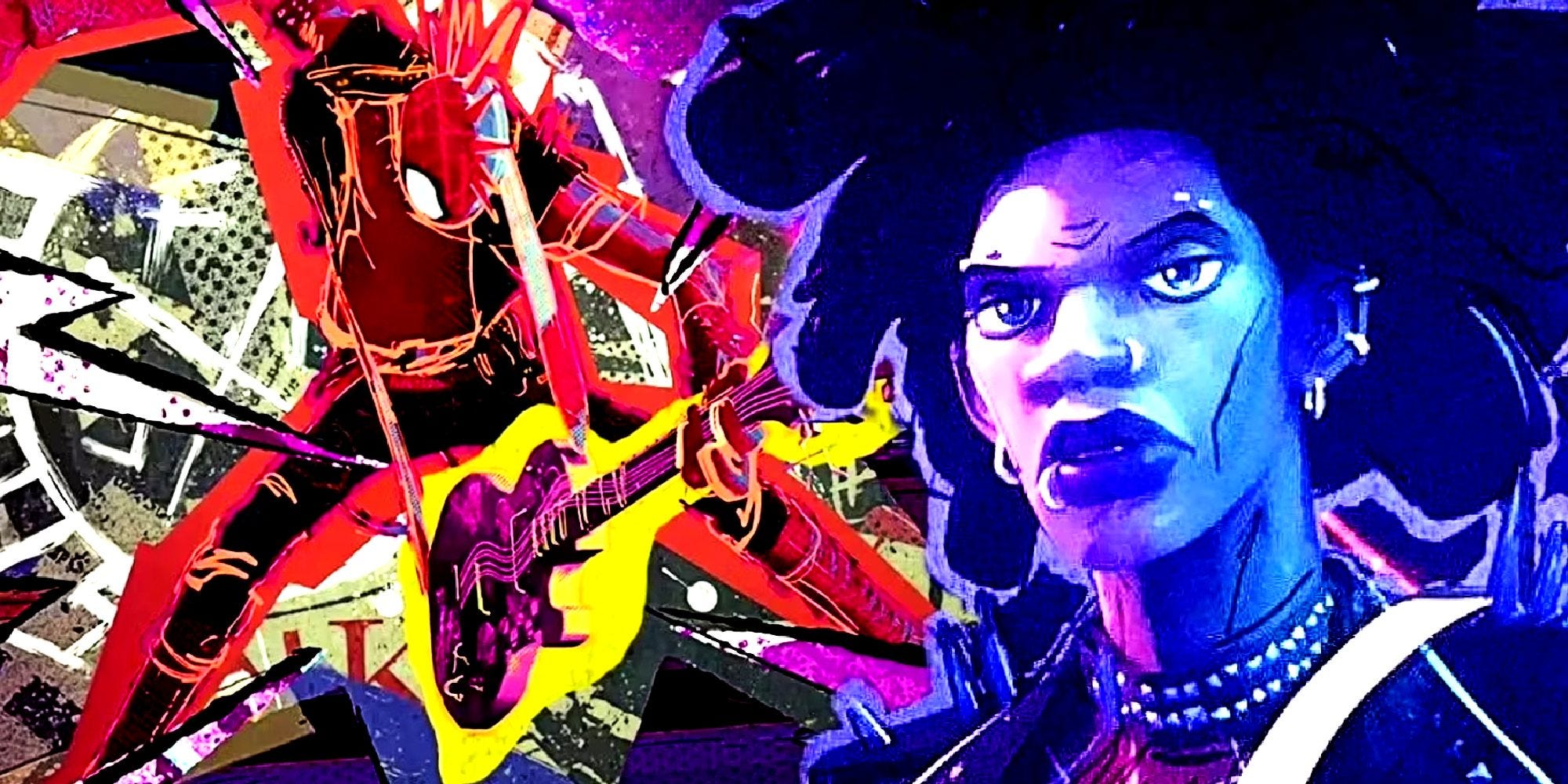
“Metaphor for capitalism, innit” – Hobie tells it like it is.

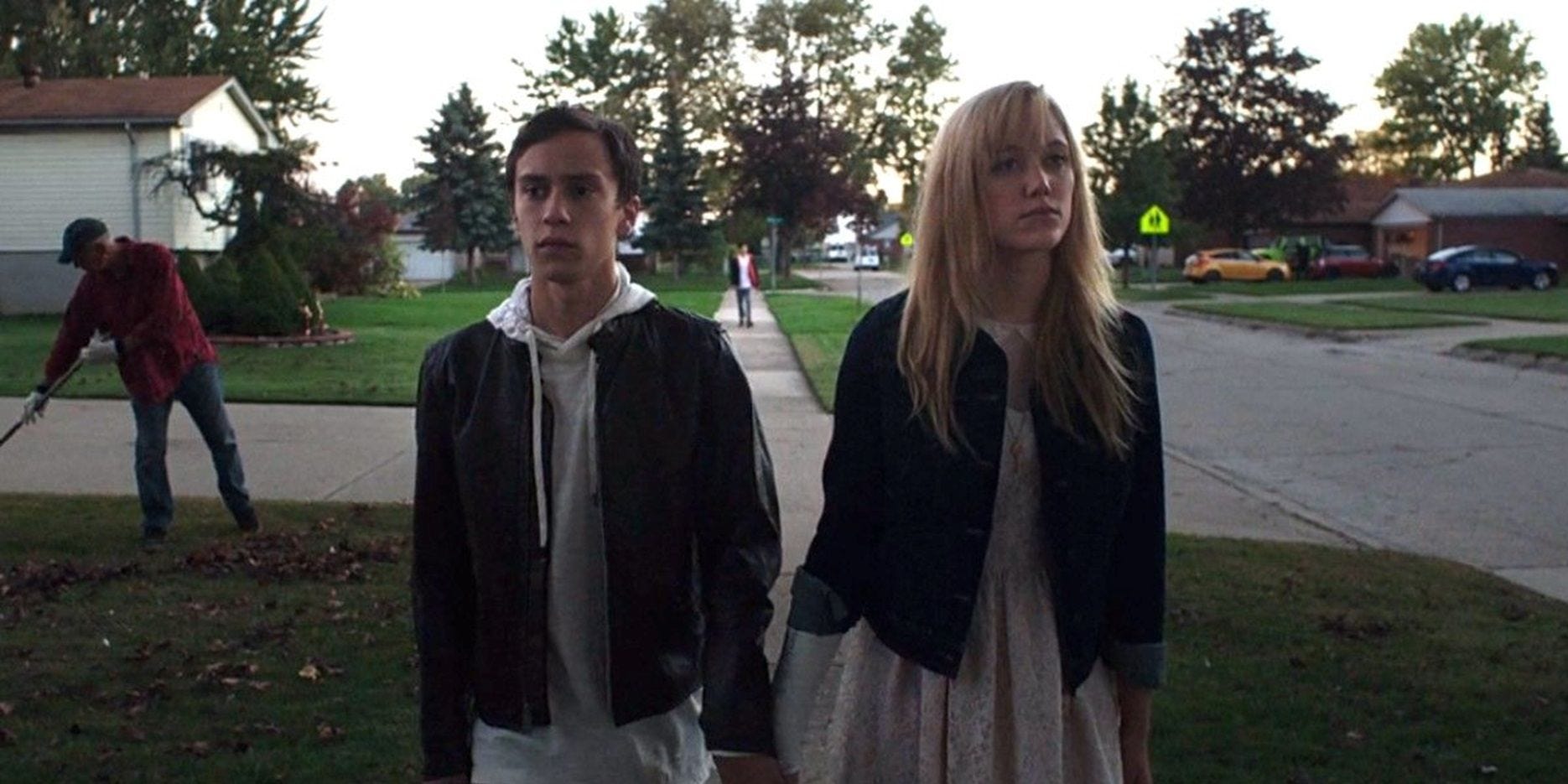
Which brings me to It Follows, a horror film that explores a lot of things, but at least one of them is investigating the unrelenting dread resulting from being pursued by an ending. In the film, Jay, a young woman becomes the target of a shape-shifting supernatural entity after a sexual encounter. This creature follows her at a walking pace, killing its victim when it catches them. The entity can look like anyone. It never stops. It can be delayed by passing the curse on to someone else, but ultimately (the repressed) always returns.

Enjoying this? Buy me a coffee?

Which makes the movie and It an eerie metaphor for Capitalism: an often invisible entity, that becomes known only to its victims (something which it bears in common with Carpenter’s They Live) and which can only be avoided by exploiting other victims in a sort of manic Ponzi scheme.

Much of the creeping fear that the movie engenders is due to Its nature. Because the creature at the movie’s core can’t be reasoned with, it has the implacable quality of a primal force. It can look like your neighbours. It can look like your parents. It wears the mask of what you know.

Like Capitalism then, the entity in It Follows demands that we keep moving and keep the questions to minimum: that we keep on running, spending and consuming. It wears us down. Slowly, quietly and relentlessly.

During the film’s finale, the protagonists try to trap the entity in a swimming pool. For a moment it appears that the gambit might have worked. Jay survives, but the final shot shows her walking away with her boyfriend while, in the background, a figure walks behind them.

The End … or is it? Mwahahaha.

That circular, open ending is one of the things that makes It Follows so compelling and disturbing to me. The curse hasn’t been ended, it’s merely been postponed, unresolved. And that feels a lot like the emotional register of whatever this thing is that we call “late capitalism”.

We’re integrated components of a system that is dizzily documenting its own demise, but the endings that we might reasonably expect: collapse, revolution and transformation never quite arrive. (For me, there’s something of a parallel here, between that bit of old post-punk wisdom that any significant resistance ultimately gets packaged up and sold back to society as a life-style.) We’re controlled by the very system we’ve constructed. Telling ourselves that there is no alternative, instead of an ending we get packaged decline, reboots and bit-rot.

This is why the term “haunted capitalism” feels a more appropriate epithet to me than “late-stage.” Capitalism doesn’t die, it persists, populated and animated by the ghosts of futures that never fully arrived: dead city centres, empty social media networks and nostalgia for discontinued chocolate bars. We’re surrounded and invested in an epistemological infrastructure that exists only as a sort of grim hangover cure.

It’s entirely possible that Timothy Leary’s exhortation to “turn on, tune in, drop out”, might be one route out of our current predicament. Not as escapism, but as refusal. As a way of unthinking the system we’ve convinced ourselves is “natural.” Most economists seem to agree that our current economic model has its roots in the changes wrought during the 17th century such as early industrialisation, enclosure and colonial trade.

So before that, there were other logics and other systems available. Not better, necessarily, but different. So Hyper-capitalism isn’t inevitable. It’s no more a function of human nature than a Saturn V rocket is a function of a matchstick.

Having fun? You could buy me a cuppa, Guv’nor

It Follows doesn’t offer a clean ending. But then neither really does Capitalism. That is its horror and its ultimate trick, teaching us to fear its (almost but never quite materialising) collapse while numbing us to the horror of the present. Perhaps, it’s more accurate to think of it as a curse that we carry, not a structure we can challenge.

So, to resist haunted capitalism, perhaps we have to do more than call it “late.” Perhaps we have to try to imagine the unimaginable: not an apocalypse, but a departure. A refusal. Maybe that is something that we as fantasy, horror and science-fiction writers can do. We can lean-in to the job of re-worlding our future. Rather than documenting dystopias we can attempt to imagine how we might finally break the curse, by envisioning a world that no longer accepts it.

Because, failing that, I don’t think there’s a swimming pool big enough.

Less something broadcast and more something that slipped through: Schalcken the Painter

“Turn from the light. Your breast bare. Look into the dark.”

I encountered the BBC’s adaptation of Schalcken the Painter one Christmas night in 1979. Looking at Wikipedia now, I can confidently inform you that it was shown under the Beeb’s Omnibus arts umbrella, part of the corporation’s a Ghost Story at Christmas tradition. Since then, it has rarely been repeated, although the BFI released an edition of the film on DVD about a decade ago which is where I rediscovered it.

But that first viewing many years ago, was part of the serendipity of the three terrestrial TV channels of the time. As a child, I’d just turn the dial to commune with the great collective unconscious in the sky and keep turning it until something found me.

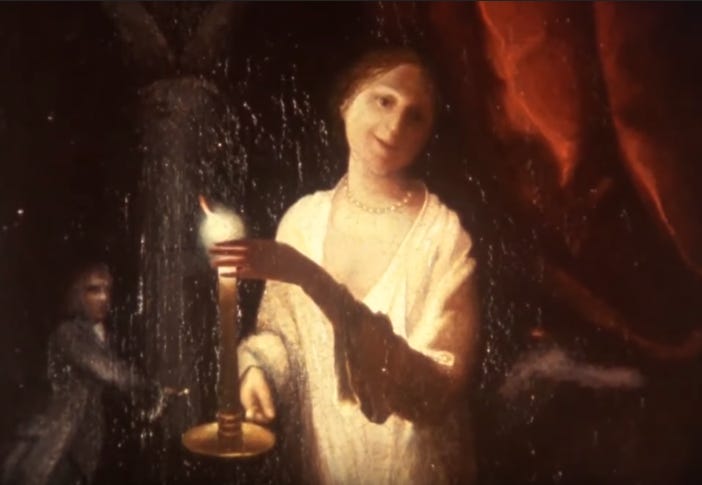
The “Schalcken” commissioned for the TV production depicting the doomed Rose and the painter in the background. Artist unknown.

Schalcken was that something. Feeling much less like a programme than something that manifested when I was up later than I should have been, it was a story beamed directly into me. Without knowing anything about it or having a copy of the Radio Times to hand, the film was charged with what Simon Reynolds might call a hauntological atmosphere, a static-tinged invocation of the past where the absence of any context felt like a presence. It was less like something that had been programmed and more akin to something that had slipped through.

The film is an adaptation of Sheridan Le Fanu’s short story of the same name. Both centre on a young Dutch painter, Godfried Schalcken, who was known for candlelit portraits of young women that were both suggestive and intimate. Apprenticed to the miserly Gerrit Dou, the story concerns one such work by the young painter. It depicts a woman carrying a candle while the figure of Schalcken himself stands behind her, sword half-drawn. A shadowy something lurks nearby.Subscribed

Narrated by Charles Gray, the film reveals that Schalcken produced the painting after experiencing a terrifying vision of his lost love, Rose, Gerrit Dou’s niece, following her marriage to an unearthly rival, Minheer Vanderhausen. After the marriage, she returns to the family home to beg for help, but Schalcken is unable to aid her. Subsequently, he becomes embittered and is ruined by ambition and regret. Cursed by strange visions of Rose’s fate, he paints the picture that is the tale’s inspiration.

Looking back now, for me the most striking aspect of Leslie Megahey’s production was its sound design. The foley work is close-miked, claustrophobic and opinionated. Coins clatter guiltily. Mealtimes are a medley of scraped cutlery and clocks ticking. Above all, the ghoulish Vanderhausen is introduced by a subtle creaking cue and a basso throb.

Maurice Denham is at his gnomic best as the acerbic Gerrit Dou. (Setting up one scene for his students, he dismissively indicates his two models: “St Anthony. Temptation. Devils … you will imagine the devils”). Jeremy Clyde’s Schalcken is at once amoral and careerist. Cheryl Kennedy’s Rose is, alas, little more than a human plot point. And there is something magnificently ghastly in John James’ monolithic Vanderhausen.Subscribed

Many of the film’s scenes are painterly tableaux that echo the Dutch Masters. They are composed as slow, locked-off shots demanding attention and suggestive that things are happening just outside their frame. The overall pace is profoundly mesmeric. As a kid who revelled in the reckless blood-spurting, page-turning chaos of 2000 AD, the film’s sense of stillness was agonising and compelling.

If Le Fanu’s original tale is a masterful example of gothic grimoire, Megahey’s adaptation is more satisfyingly grounded and disturbing, I think, in that it explores aspects that the source material only hints at. Namely, the commodification of the erotic, the sex worker economy and the casual treatment of Rose as an object for sale to the highest bidder, in this case the eminently unsuitable Vanderhausen.

Encountering this film without any context made it all the more unnerving. Lacking much to orient me, its docudrama approach, unsettling atmosphere and languorous sense of dread were perfect. But I do wonder how much of its impact was a function of the way it found me, free of frames of reference or any sense of what it was.

A perfect example, perhaps, of the uncanny as a format rather than a plot, its final few scenes lurking in my memory for days after I saw it and still capable of evoking a sense of dread years later. But that mood lay not only in the tale itself, but in how it arrived, formally unplaceable, aesthetically estranged. Schalcken the Painter wasn’t just uncanny in content. For me, bathing in the flickering TV light that night, it was the uncanny

Years later, I rediscovered the film and watching it now, it’s still chilling, but since I know so much about it, its sense of dread has receded. Knowledge of its origin has dispelled its hauntological charge. That notion I had of not-knowing, the feeling I was watching something that might be forbidden has faded, taking with it the creeping sensation that instead of a slightly hokey Christmas ghost story, I was witnessing a transmission from the outside.

My weird fantasy debut The Lighthouse at the End of the World is published by Titan Books April 2026. Pre-order it here.

Questions for this issue:

  • I’d love to hear from anyone else who has encountered the uncanny as format?

Playlist

  • You can hear Sheridan Le Fanu’s original gothic tale read by the wonderful Ian McDiarmid here.
  • Watch Leslie Megahey’s the adaption here. You’ll need to login due to age restrictions (there is some nudity, well, it was the 1970s). The reproduction is low quality, although IMHO that only adds to its atmosphere.
  • The BFI’s Graham Fuller analyses the film: https://www.bfi.org.uk/features/why-i-love-schalcken-painter
  • You can buy the BFI DVD edition here. Apologies for the Amazon link but the BFI shop seems to be closed right now.

manilow magic

I think my fascination with weird spaces began as an introverted, book-licking kid, reading about the Bermuda Triangle in the pages of Unexplained magazine. Today, the Triangle might be more famous for the cheese deluxe of the Barry Manilow song, but back then it was a terrifying region where the certainties of Cartesian space and time seemed to falter, with planes, boats, and people entering it only to vanish mysteriously. (Most notably, Spielberg’s Close Encounters of the Third Kind even hinted cheekily at their fate.)

Francois Truffaut shuts his eyes and thinks of the cheque in Spielberg’s Close Encounters of the Third Kind

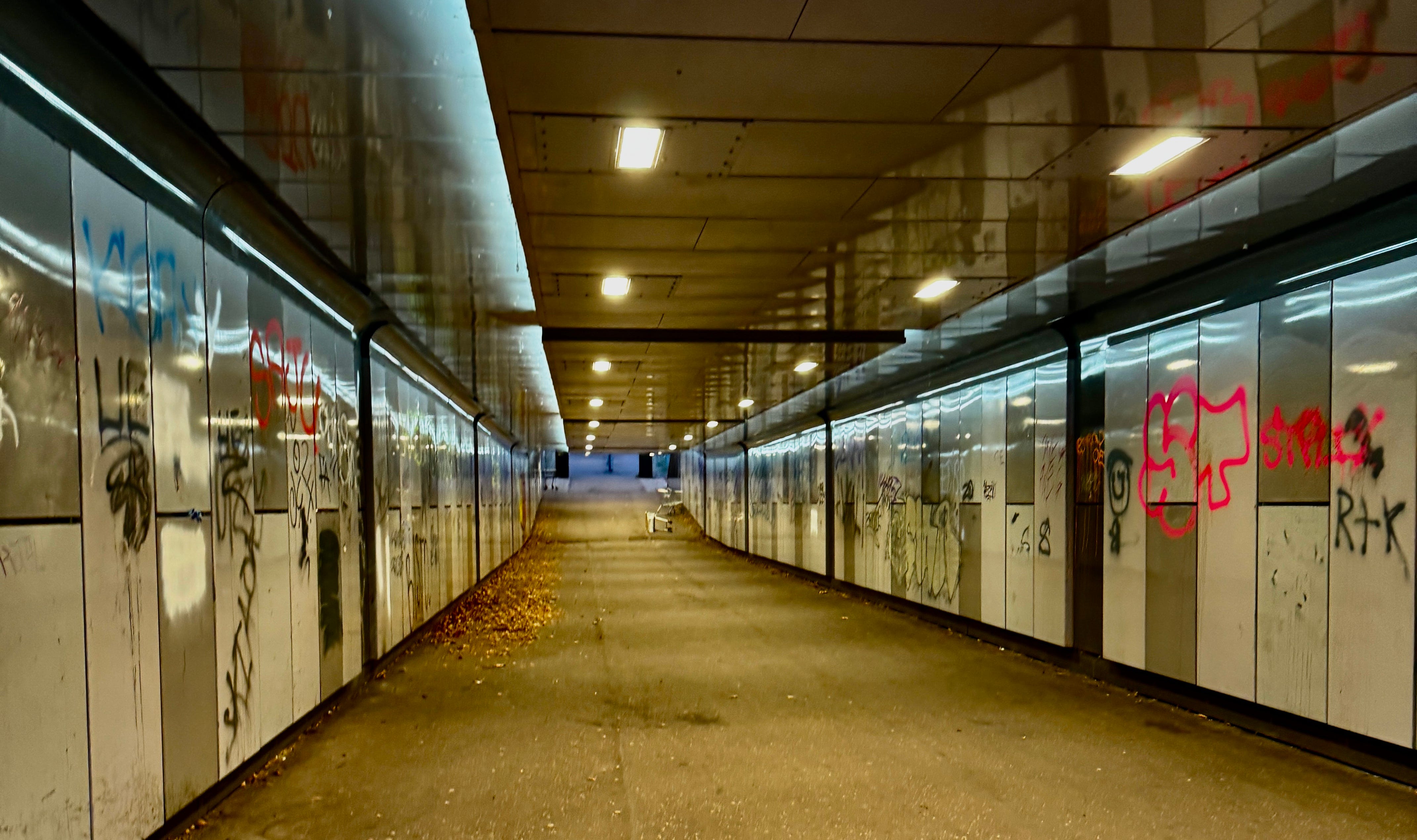
As I grew older, I discovered these haunted landscapes in the pages of the “old weird” e.g. Machen’s The White People, Blackwood’s The Willows, and later, the deeply ambiguous Québécois outback of Atwood’s Surfacing. These uncertain, liminal spaces got under my skin, needling away, stinging like a hangnail.

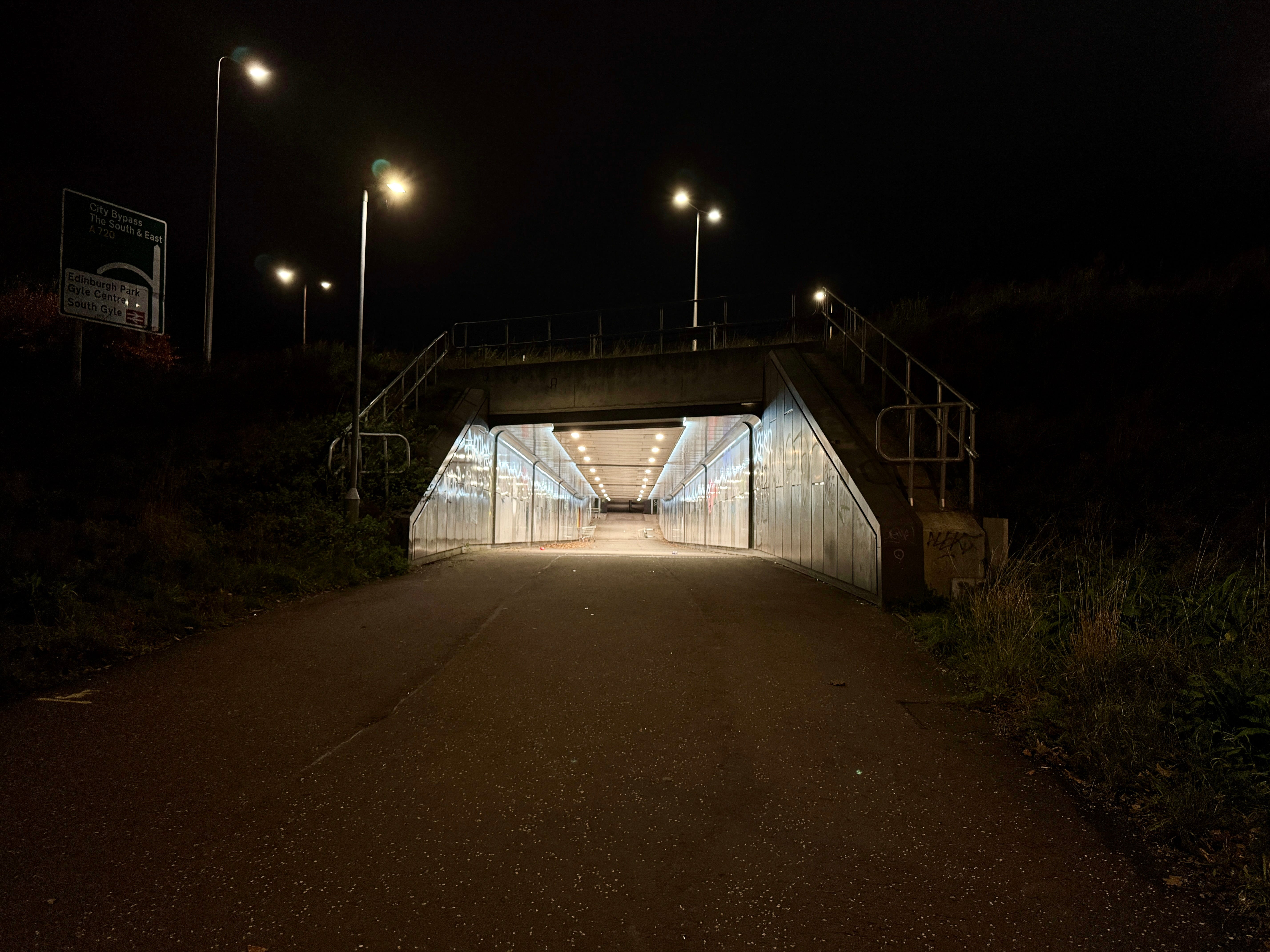
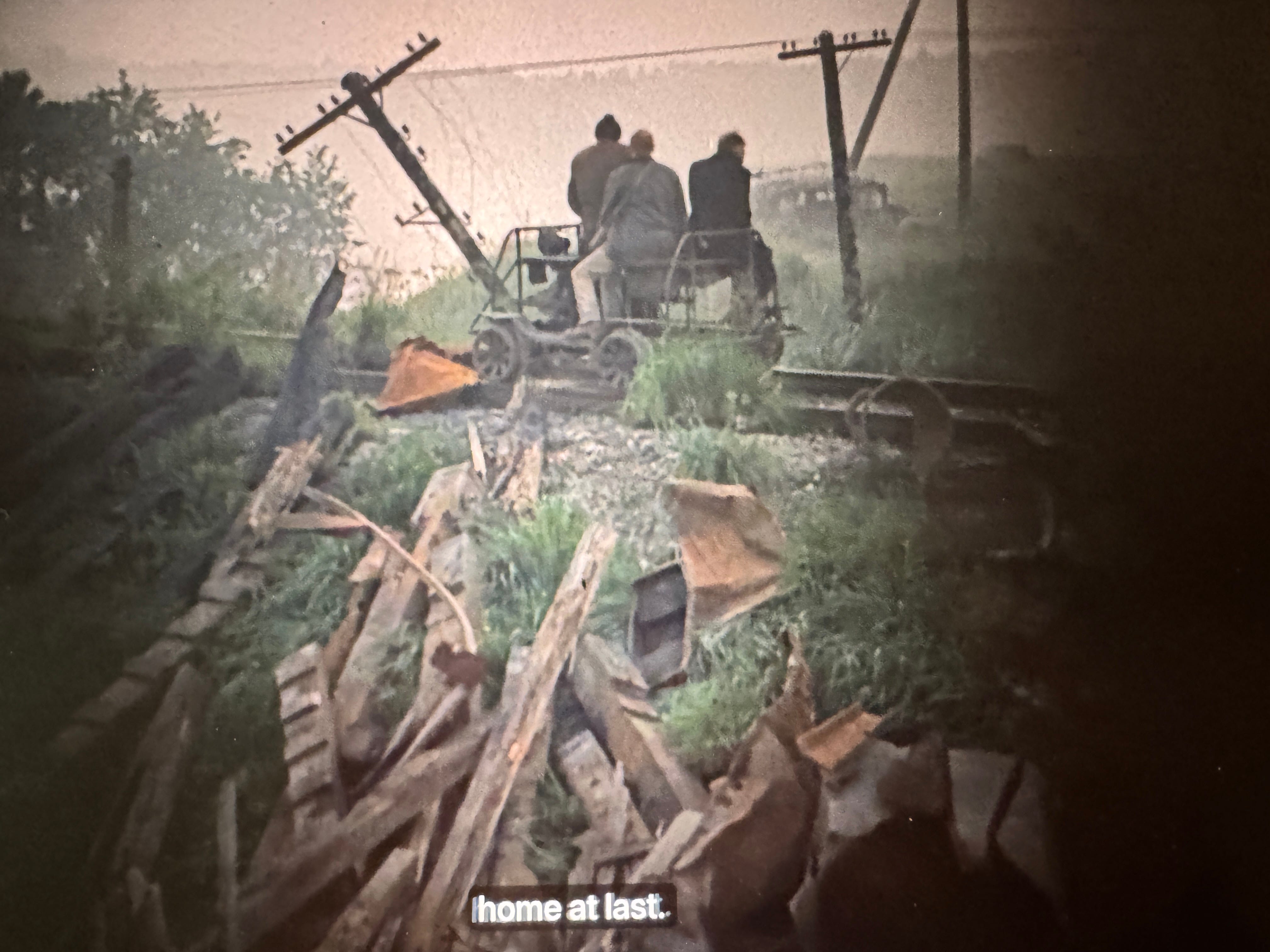
This obsession only intensified when I came across Vandermeer’s Annihilation and the Strugatsky brothers’ Roadside Picnic. In both of these novels, the weird landscape is the driver of the narrative. Roadside Picnic, set in the Soviet Union in the 1970s, explores the aftermath of an alien visit that has left behind mysterious “Zones” filled with gravitational anomalies, toxic hazards, and sinister locales where the shadows “look wrong”.

In the face of the economic exigencies of the late-period Soviet Union, human “Stalkers” sneak into these zones to make off with little-understood, abandoned technology to sell for mis-use on the black market. Red Schuhart, the novel’s hard-bitten protagonist, likens their actions to “children playing with matches in a house on fire. The Zone is the fire, and we’re too blind to see the danger.”

The Strugatskys’ Zone is an eruption into human reality, of what Lovecraft (everybody’s favourite tomb-faced, racist bell-end) would have called “the outside”. Consequently, the novel is much less about aliens than it is about the limits of human knowledge and subsequently the human condition.

Similarly, in Vandermeer’s Annihilation, Area X is a weird space that infiltrates human power structures, replacing them with a mycological plane reminiscent of Deleuze and Guattari’s “body without organs”. As its protagonist (known only as the Biologist) discovers, Area X is a place where the human experience is interrogated, undermined, and ultimately transformed.

What keeps me coming back to these books is their conjuring of non-human presence as absence, evoking Mark Fisher’s definition of the eerie as, “the sensation of … something present where there should be nothing.” In Roadside Picnic, this absence is the unresolved mystery of the aliens’ purpose. Some believe that Earth was just a stopover, humanity unnoticed, while others think the aliens never left, still lurking invisibly in the Zone: the mutations in Stalkers’ children hinting at, perhaps, a slow-motion genetic invasion.

Similarly, Vandermeer’s Area X is a metaphor for the climate crisis, a rebellion against humanity and capitalism by a Gaian hyper-entity. The Biologist’s journey through Area X, where the landscape observes her as much as she observes it, suggesting a move beyond the human towards a type of becoming-animal futurity.

These books resonate now more than ever, I think, because the early 21st century is a profoundly weird and eerie space. The climate crisis, flame-throwing cyber-dogs and generative AI have woven a sense of the uncanny, of presence-where-we-know-there-is-only-absence, into the texture of everyday life. The Bermuda Triangle, the Zone, and Area X have swallowed the world, making our sense of the human feel contingent and in urgent need of reinvention.

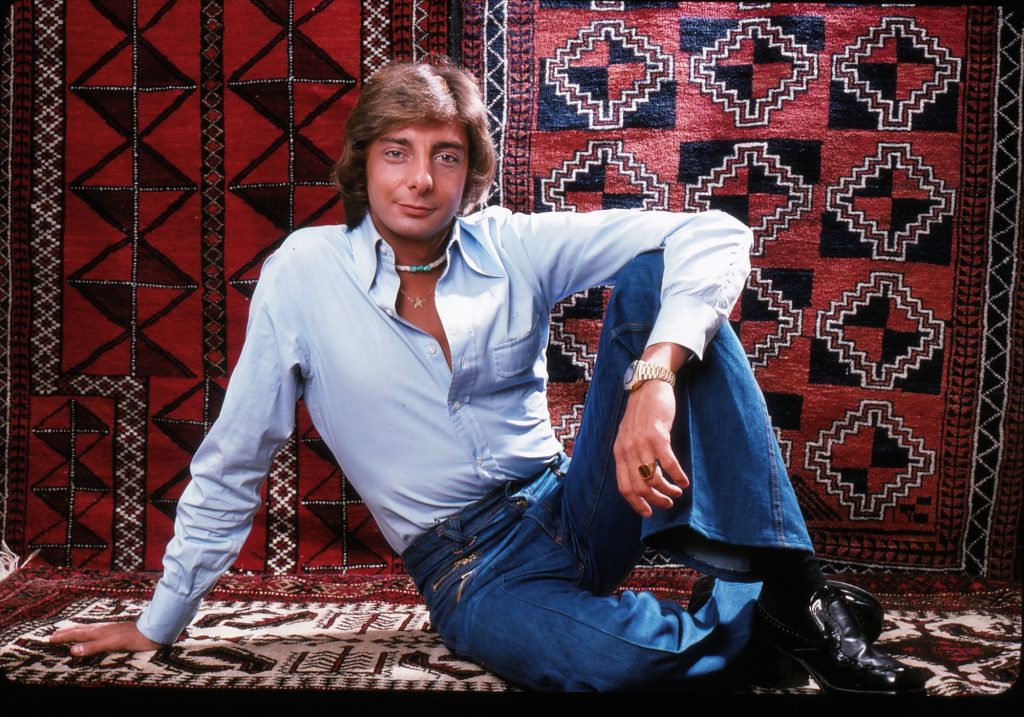
The Maz-master is a man at ease with his uncanny carpet choices

As Bazzer the Mazzer once sang,

“Bermuda Triangle, makes people disappear.

Bermuda Triangle, don’t go too near.”